Welsh Gender Service — our coverage
- Our position — what was decided, what has not been shown, and what we ask
- What the published record shows — the running record, updated as the position changes, with full revision history
- The papers justifying the gender surgery pause do not hold up — the two impact assessments published on 17 September
- What the Joint Committee said, and what it did not — the meeting of 22 September, with a timestamp index to the recording
- The pause may be right. The process cannot show it — where this stands, stated as a view
- The terms of reference, read in full — what the governing document settles, and what it leaves open
- The published record, analysed — twenty-eight documents read against each other (seventeen at publication, eleven added since), every finding graded and independently checked
- Where the record stands — our view after the terms of reference, and eight things we ask
- What the decision record shows — our view after the papers of 24 August were published (you are here)
- Our correspondence — every approach to a public body, what was asked, and where each stands
- Commitments made — what these bodies have promised, and whether it has been kept
NHS WALES · WELSH GENDER SERVICE · OPINION
This is an opinion piece. Its factual claims rest on documents the NHS Wales Joint Commissioning Committee and Cardiff and Vale University Health Board have published or released to us, cited by their numbers in our analysis of the published record (D1 to D27). Where we give a view, we say so. It follows Where the record stands (6 October), which it updates and does not replace. Published 23 October 2026 (UK time).
Our position now
On 6 October we said the pause may be justified and the published record did not show that it was. We said we would revise that view, and say so publicly, if a decision record were published. It now has been, and this is the revision.
In our view the record shows a decision taken quickly, on a signal rather than a finding, without the impact assessments the Committee’s own papers said would support it, and widened in discussion to include patients whose surgery was already booked. It does not show that pausing all three procedures, for everyone on the pathway, was proportionate then or is proportionate now. And the Committee has told us it will publish nothing that would let anyone outside test that until its review is complete.
That makes us more concerned than we were, not less. It does not make us think the pause was wrong. Precaution in the face of a credible signal can be right. What the record now makes plain is how much of the case rests on the signal alone.
What the record now shows, and what is to the Committee’s credit
- It published papers it did not have to. The report, the draft minutes and the Chair’s Action from a private session were released with the sub-committee’s papers for 30 October, and the Committee describes that as going beyond what it would ordinarily publish (D26). That is the right instinct and we record it first.
- The route followed its own process. The Senior Leadership Team endorsed the report on 17 August (D24). The sub-committee discussed it in private on 24 August (D25). A Chair’s Action, after consultation with the sub-committee’s lay members, approved the recommendations the same day (D26). A formal letter went to Cardiff and Vale on 25 August, and an Executive Lead is named (D22, D23). This is the route the other Level 3 escalations in the Committee’s papers followed.
- Options were weighed. The sub-committee considered doing nothing, pausing all referrals into the service, and letting patients with booked surgery proceed. It rejected the second because the evidence did not support it and the harm to a vulnerable group would be greater (D25). The wider service, including hormone therapy and psychological support, was kept running.
- Support was made a condition. The minutes record that endorsement was “contingent on appropriate support being provided for patients on the waiting list” (D25).
- Llais was consulted on the terms of reference before they were finalised, on 22 and 23 September.
What the record shows that concerns us
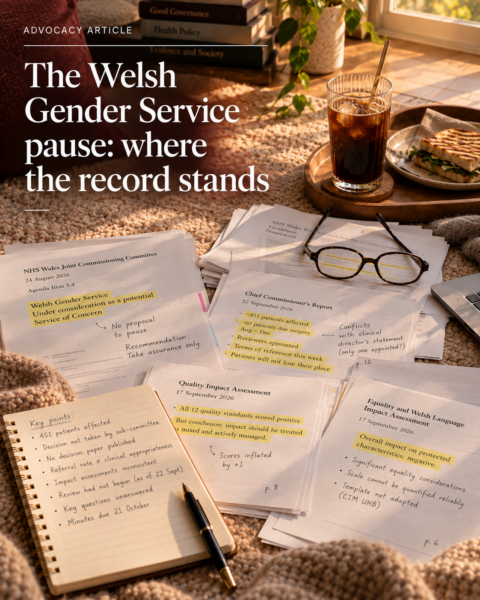
No impact assessment came first. The report’s quality and equality screening boxes both read “No”, with the note that each “will be undertaken in full to support any decisions made” (D24). Completing them was one of the actions approved afterwards (D26), and the Committee says their first versions were created on 26 August, two days after the decision (D22). Section 149 of the Equality Act does not require a written assessment at the moment of decision. The Welsh specific duties say more about assessing the likely impact of proposed policies. Whether they applied to an urgent pause is a question for lawyers, not for us. In our view a decision affecting several hundred people’s access to surgery should not have been taken with both boxes unticked.
The pause of booked surgery was not what the report recommended. The report asked the sub-committee to endorse Level 3 escalation, a suspension of referrals, a suspension of surgical assessments, and an external review of everyone on the waiting list (D24). Pausing operations already scheduled was added in discussion. Members considered letting people with booked dates go ahead and decided that “the existence of a booked surgery date did not, in itself, resolve the concerns raised” (D25). That is a reason, and it is now public. But it was the most consequential part of the decision for patients, some of whom had been admitted. It was settled in an hour-long private session on a paper updated at midday, then approved offline.
The evidence is a signal, described in private more strongly than it has ever been described in public. The basis set out in the report is:
- the referral-rate comparison, about four times England’s;
- a progression rate for masculinising genital surgery;
- concerns raised verbally by a clinician, for which “written confirmation has been requested”;
- “several” complaints over two years, then three items from 12 August: material collated by one complainant from freedom of information requests, a complaint to ministers, and a whistleblowing letter (D24).
No number of complaints is given anywhere. “No completed case-level review had been undertaken before the temporary pause” (D22). Yet the report says the pattern suggests patients are “being inappropriately referred for surgery with the potential for actual harm” (D24), and the next day’s letter says it suggests they are “being excessively referred … without the appropriate assessment” (D23). Every public statement since has been more careful: a signal, not proof (D8); not a finding about any patient (D20, D22). In our view the careful version is the accurate one, and it was the careful version that should have governed the scope.
The figures still do not hold together. The report gives 36% for progression to masculinising genital surgery (D24). The letter written the next day gives 34% (D23), which the Committee now says is correct (D27). The report’s own table implies about 26 to 29%. The same table gives the first figure for feminising genital surgery, 30.1% not progressing, but no English comparison. The reasons it lists for not progressing include “patient choice”. A figure that counts people who chose not to proceed alongside people who were not appropriate for surgery cannot, without the breakdown, show inappropriate referral.
The Committee describes the risk two ways. To us it says “Serious concerns regarding the safety of the service have been identified” (D22). To patients, Cardiff and Vale’s FAQs say “No immediate patient safety concerns have been identified by the NWJCC”. Both cannot be the message patients should rely on.
Cost is listed among the considerations. The report’s impact table records that “Gender surgery is financially resource intense” and that the waiting list “could divert resources away from other required areas” (D24). We do not suggest cost drove the decision. Nothing in the minutes says it did. But it is in the paper the decision rested on, and readers should know that.
What is still not shown
- Why each procedure is paused. Masculinising chest surgery is half of all referrals, and its progression rate is recorded as comparable to England. The Committee’s answer is that the pause “is not based on a single procedure or statistic in isolation” (D27). That explains a pathway-wide approach. It does not justify one.
- How many complaints, and from whom. The Committee’s own equality assessment lists this as an action. Seven descriptions later, there is still no number.
- Whether the pause remains proportionate. The Committee says proportionality “will continue to be considered” and that it “will not publish provisional procedure-level analysis while the review is ongoing” (D27).
- The rules that decide patients’ outcomes. The review framework, the definitions, the interim criteria and the version of the service specification will not be disclosed while the review runs (D27).
- Whether everyone due surgery this year will be reviewed, and how people still waiting to be referred will be assessed. People not yet referred are outside the review (D27).
Tested against what we said would change our view
| We said we would revise our view if this were published | Now |
|---|---|
| A decision record showing the paper, the body that decided and the evidence before it | Published. It shows a process followed in form, and a decision taken without impact assessment on the evidence described above (D24 to D26) |
| Absolute patient numbers behind the masculinising genital progression rate | Not published. There are now three figures, and the Committee says numbers will follow verification (D27) |
| Case-level evidence of risk, even in summary | None. No case-level review had been completed before the pause (D22) |
| The review framework and governance process, protecting the specification’s exceptions | Withheld while the review is ongoing (D27) |
| A procedure-by-procedure proportionality review | Declined while the review is ongoing (D27) |
One condition is met, and we said we would say so: we do. It moves our view in one direction. We said on 6 October that the record showed neither that the pause was proportionate nor that it was not. That remains true of the outcome. But we now know the process by which the scope was set. In our view the burden on the Committee to justify continuing the whole pause, for every procedure, is heavier than it appeared, and its decision not to publish procedure-level analysis until the review ends means no one outside can test whether it is being met.
What we ask now
- Publish a procedure-by-procedure assessment of whether the pause remains proportionate, starting with masculinising chest surgery. Publishing reasoning does not prejudice an independent review of individual cases.
- Publish the number of complaints relied upon, distinguishing patients from others, as the Committee’s own equality assessment requires.
- Reconcile the progression figures: 36%, 34% and the report’s own table. Say what each counts, and how many people are behind each.
- Confirm that no patient will be deferred or removed at the desktop stage without being seen, and that a flag on smoking or BMI alone will not lead to deferral.
- Publish the criteria for the interim review before it takes place, and commit to reviewing everyone due surgery by 31 December.
- Bring the public description of risk into line. If there are serious safety concerns, say what they are. If there are no immediate patient safety concerns, say that to everyone.
We will put the most pressing of these to the Joint Committee for its meeting of 24 November.
What we are not saying
- We are not saying the pause was wrong, or that any referral was appropriate or inappropriate. We hold no case-level information.
- We are not saying anyone acted in bad faith. The papers show people weighing hard options and taking patients’ welfare seriously.
- We are not saying cost drove the decision. We are saying it appears in the paper.
- We are not criticising the clinicians conducting the review, the Welsh Gender Service’s staff, or the people whose concerns and complaints prompted it.
Our interests. Eden Openly is a party to this matter, not a neutral observer. Several of the documents cited here were released in answer to our own requests. Our correspondence is published at edenopenly.com/wgs-correspondence. We hold no privileged information.
Eden Openly is an independent clinical health-education publication. It receives no funding from, and has no commercial relationship with, any provider of gender-related healthcare, any pharmaceutical company, or any supplier of NHS digital systems. Our full position is in our statement of independence. Corrections and queries: [email protected].