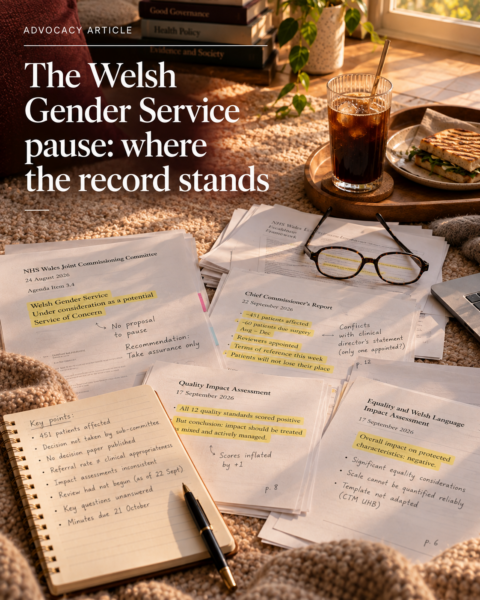
Welsh Gender Service — our coverage
- Our position — what was decided, what has not been shown, and what we ask
- What the published record shows — the running record, updated as the position changes, with full revision history
- The papers justifying the gender surgery pause do not hold up — the two impact assessments published on 17 September
- What the Joint Committee said, and what it did not — the meeting of 22 September, with a timestamp index to the recording
- The pause may be right. The process cannot show it — where this stands, stated as a view
- The terms of reference, read in full — the governing document of the review
- The published record, analysed — nineteen documents read against each other (seventeen at publication, two added since), every finding graded and independently checked (you are here)
- Where the record stands — our view after the terms of reference, and eight things we ask
- Our correspondence — every approach to a public body, what was asked, and where each stands
- Commitments made — what these bodies have promised, and whether it has been kept
Update — 10 October 2026
A nineteenth document: a second Welsh Government freedom of information release, ATISN 27436 (response dated 28 September, published 6 October), answering a request about a Member of the Senedd’s correspondence on the service. It is added to the source table as D19 and to the timeline in section 2.
It dates when the Welsh Government knew. It says the Government “was informed by the NWJCC on 18/08/2026 that concerns were being discussed at the Quality Safety and Outcomes meeting on 24/08/2026”, and that “On 25/08/2026, officials were informed of the outcome of the Committee meeting”, the day before Level 3 took effect. The public agenda of 24 August has no item on the service (D2), which fits the lay member’s account that it was taken in private session. The release also says the Government “does not have a role in the NWJCC escalation process”, and it withholds the Government’s correspondence with NHS Wales on the decision under section 35(1)(a). It says “The information relating to the decision has now been published by the NWJCC”. The minutes and the decision paper have not been. An attached ministerial letter of June 2026 says officials meet the Committee monthly.
Nothing in it changes a finding or a grade. Section 10A now cites D19 alongside D18.
Update — 9 October 2026
Since publication we have read an eighteenth document: the Welsh Government’s answer to a freedom of information request about the pause (ATISN 27435; response dated 28 September, published 6 October). It is added to the source table as D18. It states that the escalation and the pause “were clinical decisions made by the NHS Wales Joint Commissioning Committee”, a further account consistent with the Chief Commissioner’s in section 2, and confirms that the Welsh Government holds ministerial briefings and correspondence with the Committee on the pause, which it withholds under section 35(1)(a). Nothing in it changes a finding or a grade. Section 10A now lists the withheld material. Our full reading is in the running record.
Corrected, 10 October 2026: the source table described the Quality Impact Assessment (D8) as “scored against the twelve quality standards”. It lists twelve and scores six; the six enabling standards record a level of activity only. The row is corrected. No finding or grade depended on it. (Amended later on 10 October: this note first labelled the assessment D7, which is the Chief Commissioner’s report.)
NHS WALES · WELSH GENDER SERVICE · ANALYSIS
Seventeen documents published about the Welsh Gender Service surgical pause (nineteen since 10 October; the two added are set out in the update panels above), read against each other and against the NHS England specification the review appears to adopt. Every quotation, figure and date was checked against the primary sources by independent readers who had not written the draft, including one reading as a hostile respondent. Each finding is graded for how firmly the documents establish it. This is an analysis; our view, and what we ask, are set out separately in Where the record stands.
Published 6 October 2026 (UK time). People are referred to by role throughout; no individual is named.
Bottom line
The terms of reference (D1) are more careful than anything published before them. They refuse to treat the referral rate as proof, they separate "was the referral reasonable then" from "is the patient ready now", and they warn against reading assurance into a small sample. On the published record, though, six problems survive scrutiny:
-
The people waiting to be referred are in no stage of the review. Yet the review is what decides whether referrals resume (4.5).
-
The desk review screens everyone referred and still awaiting assessment on BMI, smoking and hormone duration. Under the NHS England specification the review appears to adopt, smoking and BMI do not bar referral, and hormones are not required for chest surgery. A flag can lead to removal from the pathway, through a governance process that is not defined anywhere (5.2).
-
The decisive parts are deferred to documents that are not published: the review framework, the "defined governance process", the interim criteria (4.3).
-
Not everyone whose surgery was imminent is promised a review. D1 makes the second 30 of about 60 conditional on an interim review. The Chief Commissioner's report says NWJCC is "confident that all 60 can be reviewed", and the FAQs tell Stage 1 patients their records "will be reviewed" (4.4).
-
The decision record is not public. The public papers of the 24 August QSOC meeting do not record it. At the 22 September meeting a Joint Committee lay member said it was scrutinised in QSOC's private ("in-committee") meeting, and the Committee Secretary said those minutes and the paper would be published. Until they are, the paper, the route and the body that decided are not on the record, and the documents describe the decision in differing terms (2).
-
Commitments in the papers put to the Joint Committee are not carried into D1: an equality assessment "at the outset", absolute patient numbers, written protection of waiting-list position (an oral undertaking from surgeons was reported on 22 September), and a role for patient groups and Llais (6).
The evidence offered for the pause is also thinner than it looks. The procedure the concern attaches to has the smallest referral-rate gap (2.9×). The progression figures come without numbers, period or definition. The procedure with the largest gap, feminising genital surgery, is not analysed beyond one table (3).
We do not say any referral was right or wrong, or that the review will be unfair. We say the published terms leave the parts that decide outcomes undefined, so no one outside can tell. Every quotation, figure and date in this analysis was checked against the primary sources by independent readers who had not written the draft, including one reading as a hostile respondent. The errors they found were corrected before this version; the most significant are listed at the end of section 10.
1. The corpus
Every document below was read in full, from the copy the publisher serves. PDFs were read as extracted text and, where layout mattered, as page images. Each published document we rely on is held under a change watch where the publisher's site allows it, so a silent revision would be caught; the checksum is the MD5 of the file as served on 6 October. People are referred to by role throughout. Where a document names an individual officer, the name is not repeated here.
| # | Document | Publisher | Date on document | What it is |
|---|---|---|---|---|
| D1 | Terms of reference, independent review of referrals for gender-affirming surgery | C&V UHB and NWJCC (two copies) | Cover says "September 2026". PDF generated 5 Oct 2026 | The governing document for the review. 10 pages: a cover dated September 2026, eight pages of text, and a back cover. No version number, named author or approving body in the text |
| D2 | QSOC agenda, 24 Aug 2026 (v2) | NWJCC | 24 Aug 2026 | Public agenda, 14:00–16:30 |
| D3 | QSOC item 3.4, Director of Commissioning (MHLDVG) report | NWJCC | 24 Aug 2026; SLT noted 17 Aug | The only 24 Aug paper we read that names the service (D2 lists the others) |
| D4 | QSOC item 3.5, escalation trajectories cover | NWJCC | 24 Aug 2026 | Services in escalation |
| D5 | QSOC item 4.1, risks assigned to QSOC | NWJCC | 24 Aug 2026 | Risk register extract |
| D6 | JC item 2.2.1, QSOC highlight report, with the Escalation Framework as appendix | NWJCC | For JC 22 Sep; SLT noted 16 Sep | QSOC's own account of its 24 Aug meeting to the Joint Committee |
| D7 | JC item 2.3, Chief Commissioner's report | NWJCC | For JC 22 Sep; SLT endorsed 9 Sep | The fullest account of the decision |
| D8 | JC item 2.3 appendix 1, Quality Impact Assessment (QIA) | NWJCC | Attached to D7 | 10 pages, listing twelve quality standards and scoring six of them (corrected 10 October 2026: previously “scored against the twelve quality standards”) |
| D9 | JC item 2.3 appendix 2, Equality and Welsh Language Impact Assessment (EWLIA) | NWJCC | Attached to D7 | 16 pages |
| D10 | JC item 1.5 action log; item 2.1 Chair's report; item 4.1 Joint Assurance Framework | NWJCC | For JC 22 Sep | Checked for any trace of the escalation |
| D11 | Joint Committee meeting, 22 Sep 2026 | NWJCC (public recording) | 22 Sep 2026 | Our transcript, made from the automatic captions. Captions mishear and repeat. We quote only what the context confirms |
| D12 | News: "Update on the Welsh Gender Service Surgical Referral Pause – 4th September 2026" | NWJCC | URL says 3 Sep; page title says 4 Sep | NWJCC's first public statement (a C&V statement of 28 Aug is quoted in our earlier coverage) |
| D13 | News: "Progress update on the … surgical referral pause" | NWJCC | 23 Sep 2026 | |
| D14 | News: "Details of the Independent Review … are now available" | NWJCC | 6 Oct 2026 | Announces D1. Retitled twice later on 6 Oct; now "Details of the Independent Clinical Review of Referrals for Gender Affirming Surgery". Text unchanged |
| D15 | News items on the Welsh Gender Service | C&V UHB | 11 Sep, 25 Sep and 5 Oct 2026 | The 5 Oct item announces D1 and says the FAQs were developed jointly with NWJCC |
| D16 | Welsh Gender Service update FAQs | C&V UHB | Last updated 17 Sep, 23 Sep and 5 Oct 2026 | Patient-facing. The 5 Oct version is the one compared with D1 |
| D17 | NHS England service specification 1780, Gender Identity Services for Adults (Surgical Interventions) | NHS England | Change log runs to version 4, December 2021 | The standard D1 says the review will apply. D1 does not name a number or version |
| D18 | Freedom of information release ATISN 27435, “Gender services”: response and terms of reference for oversight meetings | Welsh Government | Response 28 Sep 2026, published 6 Oct 2026 | Added 9 October 2026, after publication. Says the escalation and the pause were clinical decisions made by NWJCC; withholds briefings and correspondence under s.35(1)(a) |
| D19 | Freedom of information release ATISN 27436, “Gender services”: response and an attached ministerial letter of June 2026 | Welsh Government | Response 28 Sep 2026, published 6 Oct 2026 | Added 10 October 2026, after publication. Says NWJCC told the Welsh Government on 18 Aug that concerns would be discussed at QSOC on 24 Aug, and told officials the outcome on 25 Aug; says the Welsh Government has no role in the escalation process; withholds correspondence with NHS Wales on the decision under s.35(1)(a) |
File fingerprints (MD5, as served):
-
D1, C&V copy and NWJCC copy:
9016C01548B6748C89DB0B173B8A2A00, 708,046 bytes. The two copies are identical to the byte. -
D3:
9B3CB83E5AA96C9445E6A41F2368AA5A, 244,462 bytes. -
D6:
63B9BB462E88EB01DA3D4A7BD7FA5500, 537,364 bytes. -
D8:
E87AB43FF0E71A9812BB61CFBCE44182, 371,584 bytes.
What is not in the corpus, and why it matters. None of the following is published: minutes of the 24 Aug QSOC meeting (the Committee Secretary said at D11 these are expected around 21 October), any paper to the Corporate Directors Group, the formal Level 3 notification to the health board, the "defined governance process" that D1 relies on, the review framework D1 says must be agreed first, and the names or number of the reviewers. A C&V statement of 28 August, quoted in our earlier coverage, could not be re-read from the C&V site in this pass. Section 2 cites it as quoted, not re-verified. (Updated, 10 October 2026: it has since been re-read. Its words are that the decision “was made following a meeting of the NWJCC Quality, Safety and Outcomes Committee on 24 August 2026”, as quoted.)
2. Who decided, and when
Who decided? The accounts differ, and the decision record is unpublished. Events in order, not to scale. D-numbers refer to the corpus in section 1.
| Date | Event | What the record shows |
|---|---|---|
| 17 Aug | Senior Leadership Team notes QSOC item 3.4 | Service “under consideration as a potential Service of Concern” (D3) |
| 18 Aug | NWJCC tells the Welsh Government | That concerns “were being discussed at the Quality Safety and Outcomes meeting on 24/08/2026” (D19; added 10 Oct) |
| 24 Aug | QSOC public meeting, 14:00 to 16:30 | No WGS item on the agenda. Item 3.4 asks members only to “Take Assurance” (D2, D3) |
| 24 Aug | As later reported to the Joint Committee | QSOC “endorsed the NWJCC’s recommendation” to escalate to Level 3 and pause (D7) |
| 25 Aug | NWJCC tells Welsh Government officials the outcome | “officials were informed of the outcome of the Committee meeting” (D19; added 10 Oct) |
| 26 Aug | Level 3 and the pause take effect | Date given in D1 (twice) and D7. No Level 3 paper or notice to the provider is published |
| 3–4 Sep | NWJCC’s first public statement | NWJCC “has taken the decision”; QSOC “concluded” the service should move to Level 3 (D12) |
| 16 Sep | SLT notes QSOC’s own highlight report of 24 Aug | Silent on the service, left to the Chief Commissioner’s report (D11); Level 3 began 26 Aug (D7) |
| 22 Sep | Joint Committee meets; QSOC’s private session is mentioned | Lay member: scrutiny was “in-committee”. Secretary: QSOC “isn’t a [forum]” that decided (D11) |
| 5–6 Oct | Terms of reference published | Says NWJCC decided; names no meeting, decision date or approving body (D1) |
| ~21 Oct | QSOC minutes of 24 Aug expected | The Secretary said these minutes and “the paper shared” will be published |
Who decided? The documents’ own words. Level 3 requires a formal paper to the Corporate Directors Group (D6 appendix). None is published.
| Document | Its words |
|---|---|
| D12 · NWJCC statement, 3/4 Sep | NWJCC “has taken the decision”; QSOC “concluded” on Level 3 and the pauses |
| D7 · Chief Commissioner’s report | QSOC “met and endorsed the NWJCC’s recommendation” on 24 August |
| D9 · Equality impact assessment | “the decision taken by the JCC to escalate” into Level 3. “JCC”: organisation or committee? |
| D11 · Committee Secretary, 22 Sep | QSOC’s role is to “scrutinise and advise”; the decision followed escalation processes |
| D13, D14 · NWJCC updates | “On 24 August 2026, NWJCC took the decision to pause referrals …” |
| D6 · QSOC’s own highlight report | Covers the public meeting only: no mention of the service (see 16 Sep above) |
The documents describe the decision in differing terms. D1 says NWJCC placed the service in escalation and paused referrals; D16 says NWJCC paused referrals and asked C&V UHB to do so, without mentioning escalation. D13 and D14, word for word the same, say "On 24 August 2026, NWJCC took the decision". D9 says "the decision taken by the JCC", which could mean the organisation or its Joint Committee. D12 says both that NWJCC "has taken the decision" and that QSOC "concluded". D7 says QSOC "endorsed the NWJCC's recommendation". The health board's statement of 28 August, as quoted in our earlier coverage, said the decision "was made following a meeting of the NWJCC Quality, Safety and Outcomes Committee on 24 August 2026".
At the Joint Committee on 22 September (D11), three speakers added to this:
-
The Chief Commissioner: "To reach our decision to [place] a service into escalation"; "it was determined that we should place the Gender Service into level three"; "We took the decision to pause gender affirming surgery and to pause assessments for surgery". On scope: "We did consider whether that was the appropriate level of escalation", including limiting it to those awaiting assessment, and "our clinicians advised us that the most appropriate decision, is the one that we have taken."
-
The Joint Committee lay member who spoke to QSOC's report, on QSOC's private session: "the level of detail and scrutiny that took place in the in-committee meeting of the Quality Safety Outcomes in-committee meeting"; "we did our job in terms of putting a lot of scrutiny into the information that was placed before us."
-
The Committee Secretary: QSOC's role "is to scrutinise and advise decision making. That isn't a [forum] that's made this decision. It's a decision that's followed our established governance processes for escalation." He said "all of those minutes and the paper shared will be shared in public".
2.1 What the public record of 24 August shows
-
The public agenda (D2) has no item on the Welsh Gender Service.
-
The only 24 August paper we read that names it (D3, item 3.4) was noted by the Senior Leadership Team on 17 August. It says the service "is currently under consideration as a potential Service of Concern" and that "enhanced governance and oversight arrangements are being considered". Its recommendation is that members "Take Assurance that patient safety risks or issues within commissioned services are being managed and monitored". It proposes no escalation or pause. The reviews it mentions are the existing whole-service review and NHS England's separate review of gender surgery services, due in 2027.
-
Item 3.5 (D4) says "No new services have been put into escalation however there is a service of concern … being considered using the escalation framework".
-
QSOC's highlight report to the Joint Committee (D6) describes "its public meeting on 24 August 2026". It covers cardiac surgery, renal services, ambulance handovers, Caswell Clinic and more. It never mentions the Welsh Gender Service; at D11 the lay member who spoke to it said she had "deliberately" not covered the service, leaving it to the Chief Commissioner's report. It records that "one services was in escalation level 3": the auditory implant service.
Set beside this, D7 says: "On 24th August 2026, the QSOC met and endorsed the NWJCC's recommendation to: Escalate the Welsh Gender Service to Escalation Level 3, thereby pausing referrals … The Committee also considered and endorsed proposals to: Pause surgical assessments … pause gender affirming surgery … Undertake an urgent independent clinical review".
D6 is scoped to QSOC's "public meeting", and D11 explains the gap. The lay member's words place the scrutiny in a private ("in-committee") session of QSOC. So the public papers of 24 August were not where the decision was considered, and their silence on it is not evidence that it was not considered. What remains unpublished is the record of that session: the paper put to it, what it was asked to do, and what it did. The Committee Secretary has said that record will be published, expected around 21 October.
2.2 What the Escalation Framework requires at Level 3
The framework is printed as an appendix to D6. At Level 3:
-
"a formal paper will be considered by the JCC Corporate Directors Group (CDG) and an Executive Lead nominated";
-
"Formal notification will be sent to the provider re the Level of escalation and a request made for an Executive lead from the provider";
-
meetings "at least monthly";
-
"Consideration of entry on the risk register and summary of services in escalation table for Chairs report to Joint Committee".
The report the framework means is the sub-committee chair's report to the Joint Committee. D4 says: "A copy of the escalation summaries will accompany the Sub-Committee Chair's Report to the JC". That report is D6. Its escalation summaries describe the position at 24 August, two days before Level 3 took effect (D7), so they would not be expected to list the service. At D11 the lay member who spoke to QSOC's report said she had "deliberately" not covered the service "because of the level of detail that is in that report", meaning the Chief Commissioner's. The Joint Committee Chair's report (D10) does not mention it either. The Joint Assurance Framework (D10) calls the escalation "an emerging area of strategic risk". The risk-register extracts published are dated 31 July, before the escalation, so the absence of an entry there proves nothing. No CDG paper and no notification letter is published.
The framework enters Level 3 "Where there is evidence that the Action Plan developed following Level 2 has failed to meet the required outcomes or a serious concern is identified". The published record shows no Level 1 or Level 2 stage for this service. If none occurred, the route must have been "a serious concern". The documents describe concerns about referral appropriateness and clinical governance; D16 adds that "No immediate patient safety concerns have been identified by the NWJCC". No document says which concern met the Level 3 threshold. The framework does not list a pause of referrals as a Level 3 measure. D6 does record that Caswell Clinic's admissions "were paused" in the course of its escalation; D6's own dates for that service's escalation are not consistent with each other, so we draw nothing from the sequence.
2.3 Reading the attributions fairly
Read together, the most natural account is this. NWJCC as an organisation, through its executive (the Chief Commissioner says "We took the decision"; D8 says leadership of the escalation "sits with the JCC Senior Leadership Team"), decided to escalate and pause, on clinical advice. QSOC scrutinised that in a private session and endorsed it. "NWJCC" names the organisation, not only its Joint Committee, which held no formal meeting between 21 July and 22 September (D7); the Chair's report lists a strategy session on 18 August whose listed topics do not include the service (D10). This account reconciles D1, D7, D11, D13, D14 and D16, and D9 if "the JCC" there means the organisation. It fits D12 only in part, since D12 has QSOC "concluding".
That is an inference from statements, not a record. The record itself, the paper, the meeting that took the decision, its date and the advice before it, is not published.
What would settle it: the minutes of QSOC's in-committee session of 24 August and "the paper shared", which the Committee Secretary has said will be published; the Corporate Directors Group paper required at Level 3; the Level 3 notification to C&V UHB; and the Senior Leadership Team record for the days between 17 and 26 August.
3. The numbers
Every figure in the corpus was copied out and checked against every other figure for the same thing. The arithmetic was run, not estimated.
3.1 Referral rates, 2025/26 (source: D7 table; D1 repeats the overall rates)
| Procedure | Wales referrals | England referrals | Wales per 100k (printed) | England per 100k (printed) | Ratio from printed rates | Ratio from the counts |
|---|---|---|---|---|---|---|
| Masculinising chest (MCS) | 201 | 904 | 6.3 | 1.5 | 4.2× | 4.1× |
| Masculinising genital (MGS) | 53 | 332 | 1.7 | 0.6 | 2.8× | 2.9× |
| Feminising genital (FGS) | 149 | 567 | 4.7 | 1.0 | 4.7× | 4.8× |
| All three | 403 | 1,803 | 12.6 | 3.1 | 4.1× | 4.1× |
Populations used: Wales 3,186,600; England 58,620,100. The rows add up (201 + 53 + 149 = 403; 904 + 332 + 567 = 1,803) and the printed per-100k figures are correct to one decimal place.
What the table shows that the prose does not:
-
The procedure the progression concern attaches to has the smallest gap. MGS is 2.9× from the counts (2.8× from the printed rates), below the 3–5 times range given in D1, D7 and D8. The largest gap, 4.8×, is for feminising genital surgery, which no document analyses beyond the D7 table. Different rankings on two measures do not by themselves undermine a combined rationale, but no document explains how the two relate.
-
The comparison is with England only. D1 and D7 use an English denominator. D8 says "comparator areas in England and Scotland" and D3 says "England and in other nations in the UK". No Scottish or Northern Irish figure appears anywhere in the corpus.
-
A referral rate measures output, not appropriateness. D1 says so itself: the difference "does not, in isolation, establish that either the Welsh or English referral threshold is clinically appropriate." That sentence is to D1's credit. It also means the rate cannot by itself justify the pause.
3.2 Progression to surgery
| Document | MCS | MGS | England comparator | Denominator named |
|---|---|---|---|---|
| D1 | 97% "comparable" | 34% | "approximately70-90%", attributed to what "NHSE advisors suggest" | "referred by the WGS" / "WGS referrals" |
| D8 | 97% | 36% | none given | "patients listed for" each procedure |
| D12 | not given | "significantly lower proportion" | English gender services | "following referral" |
No document gives the period, the number of patients behind either percentage, or what counts as "proceeding". D8 promised that "Absolute patient numbers will be added alongside these percentages once verified". D1, published later, adds none. Two different figures (34% and 36%) are given for what may be the same measure. D1 calls the base "referrals"; D8 says "listed for". D8 also uses "listed" loosely, of referrals to the surgical waitlist, so these may or may not be the same denominator. Nothing published says. D8 also reports surgical waits of up to about eight years. A progression rate for a recent referral cohort cannot be read without knowing how long those patients have had to progress.
3.3 Cohort sizes
| Figure | Source | What it counts |
|---|---|---|
| ~60 | D1 ("Estimates from surgical providers"); D7 | Planned surgery between 26 Aug and 31 Dec 2026 |
| ~100 | D8 | "have a surgical date within the current year" |
| ~450–500 | D8 | "potentially affected overall" |
| 30 + 30 | D1 | Interim review after 30 assessments "to determine the need to assess the further 30" |
The ~100 and ~60 are not reconciled anywhere. They may count different windows, or come from different sources (surgical providers for the 60; D8 does not say). No document says how many of the 450–500 are in each of the three groups, or how many have not yet been referred at all (see section 4).
3.4 The QIA's own scores do not follow its own rule
D8 defines the impact score as the "product of previous columns" (impact sign × level). The printed scores are:
| Standard | Sign | Level | Product | Printed score |
|---|---|---|---|---|
| Safe | +1 | 3 | 3 | 4 |
| Timely | +1 | 3 | 3 | 4 |
| Effective | +1 | 3 | 3 | 4 |
| Efficient | +1 | 3 | 3 | 4 |
| Equitable | +1 | 2 | 2 | 3 |
| Person-centred | +1 | 3 | 3 | 4 |
Every printed score is the sum, not the product. Every scored standard is also marked positive (+1) (corrected 11 October 2026: this said “every standard”; D8 lists twelve and scores the six above), including Timely and Equitable, whose own text lists delay, distress, "mental health risk" and differential impact. D8's closing summary says the overall impact "should therefore be treated as mixed … rather than simply positive". The scoring table says the opposite. The EWLIA (D9) records the overall equality impact as negative.
3.5 Dates and counts of people
| Claim | Source | What happened |
|---|---|---|
| Terms of reference "published later this week" | D11, 22 Sep | Published 5 Oct (C&V) and 6 Oct (NWJCC) |
| Panel to "commence its work during the week commencing 21 September 2026", "subject to final governance approval" | D7 | No approval record published. D1 carries no date of approval |
| "we have now appointed three reviewers" | D11, about 17 minutes in | About 12 minutes later the same meeting heard: "we've appointed one person. We've got two others being appointed" |
| "one services was in escalation level 3" on 24 Aug | D6 | The auditory implant service. The Welsh Gender Service is not listed, consistent with D7's date of 26 Aug for Level 3 |
4. The terms of reference, read alone
4.1 What it does well
It is fair to start here, because several passages are better than the earlier documents.
-
It refuses to treat the referral rate as proof. The review "should not assume in advance that higher referral activity necessarily represents inappropriate referral". It must consider "population need, case mix, referral criteria, assessment practice, patient preference, procedure type, changes in clinical circumstances during prolonged waits, data definitions".
-
It separates three questions that are easily run together: whether the original referral was reasonable at the time, whether the process was properly documented, and whether the patient is ready now. It warns that "A finding that a patient is not currently ready for surgery should not, without further evidence, be taken to mean that the original referral was inappropriate."
-
It warns that "The absence of concerns in an initial convenience sample should not alone be treated as assurance regarding the wider service". It says targeted sampling "should be considered" where the priority cohort is unrepresentative.
-
It requires urgent concerns to be escalated without waiting for a meeting or report. It requires each opinion to state its evidence, what was unavailable and "the degree of confidence". It says closure of a recommendation needs evidence of implementation, not just a new document.
-
It keeps the patient's route to raise a concern separate from the review, and says raising one "should not adversely affect the patient's care".
4.2 How it is written
Counted across the whole text: "should" appears 37 times, "will" 20 times, "may" 3 times, and "must" or "shall" not at all. Almost every safeguard in 4.1 is a "should". The things written as "will" are mostly descriptions of process: patients "will be allocated", clinicians "will have regular meetings", Arden and GEM "will be asked to analyse". "Should" commonly marks a duty whose application depends on circumstances, so the count alone does not settle the status of these provisions. What it leaves unclear is which are minimum requirements, and who checks that they are met.
4.3 What it defers to documents that do not exist yet
The review's main working parts are things the terms of reference say will be agreed later. None has been published.
| Deferred item | What D1 says | Status |
|---|---|---|
| The review framework | "Before case review work begins" the clinicians and commissioner "should agree a standard review framework, evidence requirements and definitions for eligibility, readiness, appropriateness, adequate assessment and insufficient information" | Not published. No date |
| The "defined governance process" | Decisions to reinstate, defer or remove a patient "should be taken through a defined governance process". The phrase occurs four times | Not defined in D1 or anywhere else in the corpus |
| The interim criteria | "Before the interim review, the commissioner and independent clinicians should agree the criteria that would provide sufficient assurance to stop, extend or modify the review" | Not published |
| The "agreed escalation route" for urgent concerns | Concerns go "through an agreed escalation route" | Not described |
| Resourcing | "The commissioners should confirm that the available clinical and administrative resource is sufficient" | No confirmation published |
4.4 What is conditional
-
The second 30 in Stage 1. The interim review after 30 assessments is "to determine the need to assess the further 30 patients". So D1 does not commit to reviewing all of the roughly 60 people whose surgery was imminent. It does not say what happens to the second 30 if they are not assessed: reinstated without review, or held. Both D7 ("We are confident that all 60 can be reviewed before the end of December") and D16 ("The current aim is for these patients to have been reviewed by the end of December 2026") describe the plan differently from D1. Stopping early would not in itself be a failure if real assurance were obtained.
-
Stage 2. "If assurance is gained after the review of 30 or 60 patients, stage 2 will not need to proceed."
-
Stage 3b. Not stated to be conditional, but D16 says any work on this group "will depend on the findings of the earlier stages". Ten days earlier patients were told otherwise. C&V's update of 25 September said: "Patients who are currently waiting for surgery during 2027, and those who are waiting for a surgical assessment, will also have their referrals reviewed to confirm that the requirements for surgery have been met." NWJCC's update of 23 September (D13) said the same. D1 makes the 2027 group (Stage 2) conditional. For people awaiting assessment it guarantees only the desk review (3a), and does not say who goes on to full assessment (3b).
4.5 Who is not in any stage
The pause has three parts: new referrals, surgical assessments and surgery. D1 covers people at three points: listed for surgery between 26 August and 31 December 2026 (Stage 1), to be listed for surgery after that (Stage 2), and referred but awaiting assessment (Stage 3). (Corrected, 10 October 2026: this said “due surgery” and “assessed and awaiting a later date”. D1 says “listed”. The point of the section is unchanged.) There is no stage for people the Welsh Gender Service would have referred but now cannot, because new referrals are paused. D16 confirms this group is affected ("Any patient who is awaiting a referral for gender affirming surgery … will be affected"). D9 lists "those awaiting progression into the surgical pathway" in the cohort to be tracked. D1 itself says the pause continues "while the independent clinical review establishes whether there is sufficient assurance to resume referrals or surgery", but no stage examines a single person who has not yet been referred. On the text, the restart of referrals depends on findings about other people.
4.6 What is missing altogether
-
Who. No reviewer is named or counted. D1 says only "experienced independent gender clinicians". D11 gave two different counts in the same meeting. There is no statement of how independence was tested, or of conflicts of interest.
-
When. No start date, no end date, no date for the interim review, no date for the final report.
-
To whom, and published? The final report's contents are listed. D1's aims say the review advises NWJCC. Whether the final report will be published is not said.
-
Oversight. D14 says the terms of reference explain "how it will be overseen". D1 says the interim review is "in collaboration with the NWJCC and the NHSE surgical lead" and that the clinicians should "Liaise with the NWJCC on a regular basis". D8 says leadership of the escalation "sits with the JCC Senior Leadership Team". D1 names no oversight group or chair for the review itself.
-
Equality. D1 provides advocacy, communication support and reasonable adjustments in its concerns process, and "equitable" appears in its aims. It contains no equality assessment, no protected-characteristic data collection and no reference to D9 (see section 6).
-
Patients' voice. Individual patients are consulted and can seek reconsideration. No role for patient groups or Llais appears in D1. At D11 the Chief Commissioner said NWJCC meets Llais "regularly" (the captions read "Clice").
-
Which specification. "the NHS England service specification" appears three times, with no number, title or version (see section 5).
-
Feminising surgery. The word "feminising" does not occur. Every procedure-specific sentence concerns masculinising surgery, though feminising genital surgery is 149 of the 403 referrals.
4.7 The Considerations table asks a different question
D1 ends with eight key questions the independent advisors "should specifically address". They include "Is the current model clinically safe?", "Are primary care arrangements sustainable and effective?" and "Are psychiatric and mental health interfaces adequate?". These are service-wide questions. D1 does include a pathway and governance element, which touches the Governance question. Most of the others (the safety of the whole model, primary care, mental health interfaces) are not what a case-level method of case notes, a virtual consultation and a desktop check is built to answer. They overlap with the separate whole-service review D1 mentions at the end of its Plan and Objectives section. D1 does not say how the two reviews divide the work, beyond sharing "thematic findings".
5. The terms of reference against NHS England specification 1780
5.1 Which specification?
D1 says three times that the review applies "the NHS England service specification", once as "the NHS England service specification for gender affirming surgery". It gives no number, title or version. The document that fits is specification 1780, Gender Identity Services for Adults (Surgical Interventions). The copy we hold has a change log whose last entry is version 4, December 2021 (an updated list of provider locations). It still refers to Clinical Commissioning Groups, which were abolished in July 2022. Its population section covers patients "ordinarily resident in England" and expressly excludes England residents registered with a Welsh GP (it includes Wales residents registered with an English GP). It describes referrals from "a specialised Gender Dysphoria Service (that is commissioned by NHS England)". Welsh referrals therefore reach these providers through arrangements outside the specification's own text. None of this makes 1780 the wrong standard. But D1 should name it, and say whether a later version or local variation applies. Otherwise the "standard review framework" in 4.3 has no fixed reference point.
5.2 Under 1780, smoking and BMI are not referral bars, and hormones are not required for chest surgery
Stage 3a: "A desktop review will identify patients who appear not to meet one or more basic clinical criteria, including applicable requirements relating to BMI, smoking or duration of hormone treatment." Here is what 1780 says on each:
| D1 criterion | Specification 1780 |
|---|---|
| Smoking | Stop for six weeks before and after surgery, but "For patients who smoke, a referral to a surgeon may still be made and an individualised discussion of risk and likely outcome included in the pre-operative counselling and consent process." |
| BMI | Patients with a BMI of 30 or more "should lose weight before having genital surgery", and 40 or more before chest surgery. "Referral to a surgeon may still be made and an individualised discussion of risk …" |
| Hormone duration, chest surgery | "Hormone therapy is not a pre-requisite" |
| Hormone duration, genital surgery | 12 continuous months "unless the patient has a medical contraindication or is otherwise unable or unwilling to take hormones" |
Under 1780, a person who smokes, or has a raised BMI, or has had no hormones (for chest surgery), can be properly referred. The smoking and BMI thresholds govern readiness for the operation, not eligibility for referral. Hormone duration is a genuine referral criterion for genital surgery, but with stated exceptions. D1's word "applicable" could preserve this, if the framework treats these as pre-operative matters. But the desk review is built to flag exactly these three things, and D1 does not say a flag on smoking or BMI alone is not a finding of ineligibility. Two other documents point the same way. D12 describes the concern as whether patients "met the basic requirements for surgery, including factors such as BMI and overall surgical fitness". D16 says an "inappropriate" referral is one that "does not meet agreed clinical criteria", and that "Factors including BMI, smoking status, unmanaged health conditions, and overall surgical fitness are considered before a patient is referred for surgery or before surgery proceeds." D16's "or before surgery proceeds" is consistent with 1780; D12 speaks of "basic requirements for surgery" without that distinction. Neither says what 1780 says expressly: that referral may still be made.
Why it matters: this stage covers everyone referred and still awaiting a surgical assessment. At D11 it was called "this much bigger group", though no document gives the split. A flag can lead to a decision "to defer or remove the patient from the surgical pathway", through the governance process that has not been defined (4.3).
5.3 Who judges surgical readiness
Stage 1 patients were due surgery, so most will already have been assessed and accepted by an NHS England surgical provider. Under 1780, "It is the surgeon's responsibility to determine that an individual is sufficiently healthy, physically and psychologically, to undergo surgery"; the referring clinic also assesses readiness before referral. D1's Stage 1 assessment includes "Surgical discussion with readiness assessment, if clinically indicated." At D11 the reviewers were described as "psychologists and psychiatrists". The only surgical input to the case review that D1 names is the "NHSE surgical lead" at the interim review; surgical providers are consulted afterwards, on the decision. D1 does not say how readiness already accepted by a surgical team will be assessed within the case review.
5.4 The second opinion already required
For genital surgery 1780 ordinarily requires two referral letters, one from a professional "not directly involved in the individual's care and able to form an independent opinion". A patient holding a Gender Recognition Certificate needs only "a single opinion". D1 asks reviewers to record "whether the applicable referral and assessment procedure followed the NHS England service specification", which would cover this. But it does not direct them to the second opinion expressly, or ask what those opinions said. The progression concern is about masculinising genital surgery, a procedure for which the specification already requires an independent second opinion, so what those opinions said is an obvious question.
5.5 One possible explanation that 1780 itself supplies
1780 allows referral for genital surgery while a patient is still above the BMI 30 threshold, and expects weight loss before the operation. A referral made correctly under 1780 can therefore wait, or not proceed, for reasons the specification anticipates. We do not say this explains the MGS figure. The documents give no breakdown of why patients did not proceed. D1 does ask the reviewers to look at "the reasons patients did not progress following surgical assessment". The same BMI threshold applies to feminising genital surgery, and no progression rate for FGS is published anywhere. That rate would show whether the pattern is specific to MGS, as the documents imply, or general.
6. The terms of reference against the Committee's own commitments
The Chief Commissioner's report (D7) went to the Joint Committee on 22 September "For Noting", with the impact assessments (D8, D9) attached "for information" as "living documents". Together they set out how NWJCC said the pause would be managed. D1 is the document that should carry those commitments into the review. This section checks whether it does.
| # | Commitment | Where made | In D1? |
|---|---|---|---|
| C1 | "Undertake an equality assessment at the outset of the clinical review, using the available baseline cohort and protected-characteristic information, and undertake a further equality assessment following completion of the review", responsible: JCC | D9 action plan | No. D1 has no equality step, no data collection, and no reference to D9 |
| C2 | Analyse protected-characteristic and socio-economic data "using absolute numbers alongside percentages" | D9 | No |
| C3 | "Absolute patient numbers will be added alongside these percentages once verified" | D8 | No. D1 gives rates and percentages, no absolute numbers |
| C4 | Patients "returned to the surgical waiting list in their original chronological position"; "assurance that pathway position will not be lost solely because of the pause" | D8 | No. D1 is silent on waiting-list position. At D11 NWJCC reported that surgeons had given "an undertaking that patients from Wales who were paused will not have to go to the back of the queue". D16 says Arden and GEM manage the list, that "we will be liaising with them around this when surgery is reinstated", and that NWJCC "has sought confirmation" of prioritisation. The protection rests on that undertaking; it is not written into D1 |
| C5 | "meaningful engagement with affected people, Llais, advocacy/support groups and other representative organisations", setting out "who is being engaged, on what issues, by what route and at what points in the review" | D8 | No. No role in D1 for Llais or for patient and support groups. D1 does provide individual consultation and advocacy in its concerns process, and NWJCC said at D11 that it meets Llais "regularly" |
| C6 | "Communication must avoid presuming that a referral was inappropriate before the clinical review establishes the facts" | D8 | Yes. D1 is careful on this throughout (4.1) |
| C7 | "We are confident that all 60 can be reviewed before the end of December" | D7 | Not as stated. D1 makes the second 30 conditional on an interim review (4.4) |
| C8 | The review is "urgent"; QSOC "requested that this work is progressed at pace" | D7, D8, D12 | No timetable in D1 |
| C9 | The EWLIA and QIA are "living documents" to be updated as the review progresses; a clinical lead is responsible for keeping the equality assessment current | D7; D11 | No link. D1 does not mention either assessment |
| C10 | Appropriate psychological support, "particularly for those who may not be considered eligible for surgery" | D7 | Partly. D1: "The WGS remains the primary source of psychological support". D16 says the concerns inbox "is not able to provide psychological support directly" |
6.1 The desk review: three accounts of its timing
-
D7 (endorsed by SLT 9 Sep; put to JC 22 Sep): "Concurrently we are undertaking a desktop assessment of those awaiting surgical assessment to ensure that all basic eligibility criteria are met." In other words, already under way.
-
D11 (22 Sep, the same day D7 was presented): "We could do a desktop exercise just to make sure that everyone fits the criteria." Also: "I think we need to see what we find from the initial assessment of the patients who are due surgery between August and December before we move forward." In other words, a possibility, with any clinical assessment of those flagged to wait for Stage 1 findings.
-
D1 (published 5 Oct): the review framework must be agreed "Before case review work begins", and the desk review is Stage 3a, after Stages 1 and 2 in the document's order.
If D7 is accurate, desk screening of everyone awaiting assessment began before D1, and before any agreed framework, was published. D7 and D11 may describe different things: D7 a preliminary check of the data, D11 a later clinical screen. Nothing published says which. The answer decides whether any patient has already been screened on criteria that, under 1780, are mostly not referral bars (5.2).
6.2 "Independent"
D1 calls the reviewers "independent gender clinicians" and the review an "independent clinical review". D16 defines independence only as "not part of the Welsh Gender Service". Advising NWJCC is the review's stated purpose, and the interim review is held "in collaboration with the NWJCC and the NHSE surgical lead". Part of the original concern came from "NHSE clinical colleagues" (D7). None of this makes the review less independent of the Welsh Gender Service. But D1 says nothing about how independence from the commissioner and from NHS England's advisers is secured, and contains no conflicts-of-interest statement.
7. The patient-facing FAQs against the governing document
The 5 October FAQs (D16) are what most patients will read. D15 says they were developed jointly with NWJCC. Where they differ from D1, a patient relying on them is relying on something the governing document does not say.
7.1 Where they agree
The three groups and their order; online assessment by default with in-person available; urgent concerns raised without waiting; a needed further assessment does not mean the referral was wrong; the Welsh Gender Service stays responsible for care; raising a concern will not affect how a case is considered; people part-way through a series of procedures are not normally reassessed.
7.2 Where they differ
| # | D16 says | D1 says | Effect |
|---|---|---|---|
| F1 | "Decisions about ongoing patient care will continue to be made by the Welsh Gender Service" | Decisions to reinstate, defer or remove are taken "by the WGS in consultation with the surgical providers and NWJCC" through a "defined governance process" | The FAQ omits that D1 has this decision taken in consultation with the surgical providers and NWJCC |
| F2 | For Stage 1, "The current aim is for these patients to have been reviewed by the end of December 2026" | After 30 assessments, an interim review decides "the need to assess the further 30" | The FAQs tell Stage 1 patients their records "will be reviewed"; D1 does not promise review for the second 30 |
| F3 | Pause lasts "until … the necessary clinical assurance has been received and that appropriate arrangements are in place", and referrals "will only restart once … any identified improvements have been addressed" | The final report must "distinguish actions required before referrals resume from longer-term service improvements" | The two answers address the pause and the restart of referrals. The second, read literally, ties restarting referrals to every identified improvement; D1 separates pre-restart actions from longer-term improvements |
| F4 | Stage 3: "your records may be reviewed to ensure that the information needed to support your referral is available" | Stage 3a identifies patients who "appear not to meet one or more basic clinical criteria"; outcome can be "to defer or remove the patient from the surgical pathway" | The FAQ describes a records check that may lead to further assessment, and never mentions deferral or removal. D1 describes an eligibility screen whose outcome can be deferral or removal |
| F5 | An "inappropriate" referral is one that "does not meet agreed clinical criteria"; and "Factors including BMI, smoking status, unmanaged health conditions, and overall surgical fitness are considered before a patient is referred for surgery or before surgery proceeds" | Says only "applicable requirements" | Under 1780 BMI and smoking do not prevent referral (5.2). "Or before surgery proceeds" fits 1780. But the FAQ does not say that smoking or a raised BMI alone does not prevent referral, so a patient could read them as bars |
| F6 | "there are cases where … NHS England providers have identified that referral criteria had not been met" | Not stated | Only the FAQs say providers found referral criteria not met; no number, period or source is given |
| F7 | "No immediate patient safety concerns have been identified by the NWJCC" | The pause is "the safest option"; Level 3 under D6 applies where the Level 2 plan has failed "or a serious concern is identified" | Not a contradiction, but the FAQ makes plain that the escalation rests on potential rather than identified harm. That bears on proportionality (D8 asks for it to be "kept under regular review") |
| F8 | Waiting list: "we will be liaising with them around this when surgery is reinstated"; providers asked to confirm prioritisation ("has sought confirmation") | Silent | Neither document writes in the protection D8 promised; it rests on an undertaking reported orally at D11 (6, C4) |
| F9 | Outcome letters: "If the review affects your care, you will be contacted" | "The patient should be informed of the decision, the reasons for it, any further action required and the route for reconsideration" | D1's expectation that patients are informed covers every patient reviewed. The FAQ makes it conditional |
7.3 The whole-service review: one service, several histories
The last paragraph of D1's Plan and Objectives section mentions a separate review of the whole service. The corpus gives these accounts of it:
-
D16 (first answer): NWJCC "commissioned a Review of the Welsh Gender Service in 2026 but delayed it to allow for the findings of the Levy Review to be published".
-
D16 (next answer): NWJCC "planned an independent review … in 2024", waited for the Levy Review, then "subsequently commissioned a new independent Welsh Gender Service Review in 2026, and this work is progressing at pace".
-
D7: the review "has already commenced, will continue as planned".
-
D3 and D7: "Initial findings are expected in Q3/Q4 2026".
-
D1: NWJCC "has commissioned a long planned whole service and governance review".
-
D11: "something that we've been planning for a while", timed with "the Levy review".
The first two D16 answers are on the same page and do not match: one says the 2026 commission was delayed, the other that a new review was commissioned in 2026 and is progressing. Neither says who is carrying it out or what its terms are. Its terms of reference are not published.
8. The 6 October publication
D14 announces D1 on the NWJCC site, one day after C&V published the same file (D15). It is a summary. What matters is where the summary goes further than the document it summarises.
What is not new. The sentence "On 24 August 2026, NWJCC took the decision to pause referrals …" also appears, word for word, in the 23 September update (D13). Our first reading of 6 October called it a new account. That was wrong and has been withdrawn on our pages.
Where D14 says more than D1 (D15 carries the same reinstatement and "meet with patients" sentences a day earlier, and D13 said in substance the same on reinstatement):
| D14 | D1 |
|---|---|
| "Where appropriate, surgery will be reinstated as soon as an individual's review is complete." | The reviewer's opinion goes to the WGS, providers and NWJCC, who "will then determine the action required through the defined governance process". There is also the interim review after 30 cases. Reinstatement is neither automatic nor immediate on the text |
| The terms of reference "explain what the review will look at, how it will be carried out and how it will be overseen" | No oversight group or chair for the review is named (4.6) |
| "Independent gender clinicians will review relevant clinical records and meet with patients" | True for Stage 1, and for Stage 2 or 3b if they proceed. Stage 3a is a desk review with no meeting |
| The pause was "on clinical advice" | Neither D14 nor D1 says whose. At D11 the Chief Commissioner said "our clinicians advised us". D7 refers to "NHSE clinical colleagues" and D1 to "concerns expressed by clinical advisers" |
What D14 leaves out. The interim review and the conditional second 30. The conditionality of Stages 2 and 3. The criteria of the desk review. The undefined governance process. Any timetable. Any equality step. Each matters to someone deciding whether the review is fair to them.
Dates are consistent. D14 dates the decision 24 August and the window from 26 August. D1 dates the pause to 26 August twice. D7 says the service "was placed in escalation, level 3 on August 26th". Decision on the 24th, effect on the 26th, fits all three.
9. Provenance
9.1 The terms of reference file
| Property | Value |
|---|---|
| Copies | C&V (published 5 Oct) and NWJCC (published 6 Oct). Same MD5, same size: one file, two hosts |
| Cover | "Terms of Reference: Independent Review of Referrals for Gender Affirming Surgery from the Welsh Gender Service", dated "September 2026" |
| File generated | 5 October 2026, 10:52 UTC (11:52 UK time), per the file's metadata |
| Version and approval | No version number and no approving body, in the text or on the cover |
| Pages | 10: a cover (an image, so text extraction misses it), eight pages of text, and a back cover with NWJCC contact details |
A reader cannot tell from the document whether this is the approved version, or which body approved it. That matters because D7 described approval as still to come: "Subject to final governance approval". The file's other metadata bears on none of the findings and is not discussed here.
9.2 Templates and drafting
These are small things on their own. None bears on a finding. We record them for completeness.
-
D9 is on the host health board's form. Its guidance asks staff to email
[email protected]and refers to how "CTM UHB carries out its business". That is Cwm Taf Morgannwg UHB, which hosts NWJCC (D5 refers to the hosting agreement), so its form is a natural starting point. But the template text was not adapted. Its action plan has "named leads to be confirmed for each action". -
D8 is unfinished in places. Two sentences stop mid-way ("with the view to identifying guidance around a and recognition of possible personal impact and"; "review the processes in place to ensure any learning and development"). "patinet" appears twice and "super ceded" once. The scoring error is in 3.4.
-
Names of services. "Gender Dysmorphia National Referral Support Service" appears in D3 three times (twice in the text, once in its glossary) and in D7's glossary; the service is the Gender Dysphoria National Referral Support Service. D7's table heading and D3's glossary say "GNRSS". D3 calls the Welsh Gender Service the "Welsh Gender Surgery (WGS)", calls QSOC the "Quality Patient and Outcomes Committee" in its page headers, and writes "masculising". D3's and D7's glossaries both give the directorate as "MHLDVH"; their text uses "MHLDVG".
-
Impact screening on the first paper. D3, the 24 August paper that first raises the service as "a potential Service of Concern", answers "No" to both quality-impact screening and equality-impact screening. It is a routine directorate report; the decision itself later got a QIA and an EWLIA.
-
D12's date. The address says 3 September; the page title says 4 September.
9.3 The meeting transcript
D11 is our own transcript of the public recording, made from automatic captions. Captions repeat lines and mishear words. One example: the Committee Secretary's "forum" comes out as "form" ("That isn't a form that's made this decision"). We have quoted D11 only where the surrounding lines make the sense clear, and we give approximate times so anyone can check against the recording.
10. Findings graded
Grades. A: established on the face of the documents; anyone can check it by reading them. B: strongly indicated, but resting on one source or on an inference we explain. C: an open question the documents raise but cannot answer. Weight is our judgement of how much the finding matters to patients: High, Medium or Low, or a range between two.
| # | Finding | Grade | Weight | Where | What would change it |
|---|---|---|---|---|---|
| 1 | People awaiting a referral that is now paused are in no stage of the review. Yet the review is what decides whether referrals resume | A | High | 4.5 | A published stage, or a statement of how this group's position will be assessed |
| 2 | The desk review screens on BMI, smoking and hormone duration. Under specification 1780 smoking and BMI do not bar referral, and hormones are not required for chest surgery. A flag can lead to deferral or removal. (This assumes 1780 is the standard; D1 does not name it, 5.1) | A | High | 5.2 | A framework stating that these are pre-operative matters, not grounds for removal from the list |
| 3 | The review's working parts are deferred to documents not published: the review framework, the "defined governance process", the interim criteria and the escalation route | A | High | 4.3 | Publication of those documents |
| 4 | D1 does not commit to reviewing all ~60 people whose surgery was imminent. The second 30 depend on an interim review. D7 says it is "confident that all 60 can be reviewed"; D16 tells Stage 1 patients their records "will be reviewed" | A | High | 4.4; 6 (C7); 7 (F2) | A statement from NWJCC on what happens to the second 30, which D1 should then carry |
| 5 | The public papers of the 24 Aug QSOC meeting do not record the decision; a Joint Committee lay member said it was scrutinised in QSOC's private session. The documents describe the decision in differing terms, and its record (the paper, the route, the decision-maker) is unpublished | A | High | 2 | The CDG paper, QSOC minutes (including any private session), the Level 3 notification |
| 6 | D1 omits commitments set out in the papers put to the Joint Committee on 22 September: an equality assessment "at the outset", absolute numbers, written protection of waiting-list position, a role for patient groups and Llais | A | Medium–High | 6 | Amendment of D1, or a published companion document |
| 7 | The FAQs give two answers on ending the pause. The one on restarting referrals, read literally, ties it to every identified improvement being addressed | A | Medium | 7.2 (F3) | Clarification aligned with D1's split between pre-restart actions and longer-term improvements |
| 8 | The FAQs say decisions on care are made by the Welsh Gender Service. D1 says reinstatement or removal is decided by the WGS in consultation with the surgical providers and NWJCC; the FAQ omits the consultation | A | Medium | 7.2 (F1) | Correction of the FAQ |
| 9 | Three accounts of when the desk review started: under way (D7), possible and maybe later (D11), after the framework (D1) | A that the accounts differ; C as to whether they describe the same exercise | Medium | 6.1 | A dated statement of when desk screening began and on what criteria |
| 10 | The progression figures cannot be read: 34% (per referral) and 36% (per listing), no period, no numbers, no definition. The English comparator is what advisers "suggest" | A | Medium | 3.2 | Publication of the absolute numbers D8 promised |
| 11 | The procedure the concern attaches to has the smallest rate gap (2.9×). Feminising genital surgery has the largest (4.8×) and is not analysed beyond the D7 table | A | Medium | 3.1; 4.6 | An FGS progression rate, and an explanation of how FGS cases are treated in the review |
| 12 | The QIA's scores are sums, not the products it says they are, and score every scored standard positive, including Timely and Equitable, whose own text describes negative impacts (corrected 11 October 2026: this said “every standard”) | A | Medium | 3.4 | A corrected QIA |
| 13 | No reviewer is named or counted, no timetable, no named oversight group for the review, no commitment to publish, no conflicts statement | A | Medium | 4.6; 6.2 | Publication of the panel, the timetable and the reporting line |
| 14 | No surgeon is named in the case review, which includes a readiness assessment for patients most of whom surgeons have already accepted | B (composition rests on D11) | Medium | 5.3 | Confirmation of the panel's make-up, and of surgical input to Stage 1 |
| 15 | The Considerations table asks service-wide questions that case review cannot answer, and overlaps the separate service review | B | Low–Medium | 4.7 | A statement of how the two reviews divide the questions |
| 16 | D1 has no version number and shows no approval, though D7 said approval was pending. Its cover is dated only "September 2026" | A | Low–Medium | 9.1 | A version and approval statement on the document |
| 17 | D1 does not name the specification it applies | A | Low–Medium | 5.1 | Naming specification and version |
| 18 | The Level 3 steps the Escalation Framework requires are not evidenced in the public record | A as to the public record | Low–Medium | 2.2 | The CDG paper and notification |
| 19 | D14 says more than D1 on reinstatement ("as soon as an individual's review is complete") and on oversight. D15 carries the same reinstatement sentence, and D13 said in substance the same on reinstatement | A | Low | 8 | Correction, or D1 amended to match |
| 20 | ~100 with "a surgical date within the current year" (D8) and ~60 due surgery 26 Aug–31 Dec (D1, D7) are not reconciled | A | Low | 3.3 | A cohort breakdown by group |
| 21 | "England and Scotland" (D8) and "other nations in the UK" (D3) are comparators with no published data | A | Low | 3.1 | Publication of the Scottish and other UK-nation figures, or withdrawal of the claims |
| 22 | Six statements about the whole-service review's history; two on the same FAQ page do not agree with each other | A | Low | 7.3 | Publication of that review's terms of reference |
| 23 | Drafting and template defects: the host health board's EWLIA template left unadapted, "Gender Dysmorphia", unfinished sentences | A | Low | 9.2 | Corrected documents |
What we are not saying
-
We are not saying any referral was appropriate or inappropriate. The documents do not let anyone judge that, and D1 rightly says the review must not assume it.
-
We are not saying the review will be applied unfairly. We are saying the published terms leave the decisive parts undefined, so no one outside can tell.
-
We are not saying QSOC did not scrutinise or endorse the decision. A Joint Committee lay member says QSOC scrutinised it in private session; D7 says it endorsed it. We are saying the record of that session is not yet published.
Our own corrections
-
On 6 October we described D14's "On 24 August 2026, NWJCC took the decision" as a new, fourth account. It repeats the 23 September update word for word. Withdrawn on our pages the same day.
-
An earlier caveat that the two copies of D1 might differ is superseded: they are byte-identical (9.1).
In this version we also corrected our account of 24 August. An earlier draft treated the silence of the public papers as unexplained. At D11 a Joint Committee lay member said the matter was scrutinised in QSOC's private session, which explains it.
10A. What would settle this
These unpublished documents would confirm, change or close the findings in section 10. Each is a checklist item for the coming weeks.
| Document | Findings it would settle | When it is due |
|---|---|---|
| QSOC minutes of 24 August, including any private session | 5, 18 | Around 21 October (D11). The Committee Secretary said the minutes of the in-committee discussion and the paper would be published |
| QSOC papers for its next meeting | 5, 18 | Next meeting 30 October 2026 (moved from 26 October, as shown on the sub-committee’s papers page from 9 October) |
| The Corporate Directors Group paper required at Level 3 | 5, 18 | No date given |
| Welsh Government ministerial briefings and correspondence with the Committee on the pause (D18, D19) | 5, 18 | Held; withheld under s.35(1)(a). No date given |
| The Level 3 notification to C&V UHB | 5, 18 | No date given |
| The review framework and definitions | 2, 3 | D1: agreed "Before case review work begins" |
| The "defined governance process" | 2, 3, 8 | No date given |
| The interim-review criteria | 3, 4 | D1: agreed "Before the interim review" |
| Absolute patient numbers behind the progression rates | 10 | D8: "once verified" |
| The equality assessment at the outset of the review | 6 | D9: "at the outset of the clinical review" |
| The panel's names or number, disciplines and timetable | 13, 14 | No date given |
| The whole-service review's terms of reference | 15, 22 | No date given |
| Replies to our pending information requests | Several; see our correspondence record | c. 23–28 October for the three statutory requests, subject to whether a request signed with a first name only is valid (see our correspondence page); no date for the rest (condition added 11 October 2026) |
11. Sources
-
D1, terms of reference: C&V copy · NWJCC copy
-
D6, JC item 2.2.1, QSOC highlight report with Escalation Framework
-
D7 and D9, Chief Commissioner's report and EWLIA (JC item 2.3 and appendix 2): September 2026 papers
-
D10, JC action log · Chair's report · Joint Assurance Framework
-
D11, the public recording of the Joint Committee meeting of 22 September 2026 (our caption transcript; times approximate)
-
D14, NWJCC news, 6 Oct
-
D15, C&V news: 25 Sep · 5 Oct · the 11 Sep item on the C&V news listing
-
D17, NHS England service specification 1780, Gender Identity Services for Adults (Surgical Interventions)
-
C&V statement of 28 August: as quoted in our earlier coverage; not re-verified in this pass (re-read and confirmed 10 October 2026)
-
ATISN 27436 (D19), Welsh Government, response of 28 September 2026 (added 10 October 2026)
-
Our correspondence record: edenopenly.com/wgs-correspondence
Eden Openly is an independent clinical health-education publication. We are a party to this matter, not a neutral observer; our interests are set out in Where the record stands and our statement of independence. Corrections and queries: [email protected].