Welsh Gender Service — our coverage
- Our position — what was decided, what has not been shown, and what we ask
- What the published record shows — the running record, updated as the position changes, with full revision history
- The papers justifying the gender surgery pause do not hold up — the two impact assessments published on 17 September (you are here)
- What the Joint Committee said, and what it did not — the meeting of 22 September, with a timestamp index to the recording
- The pause may be right. The process cannot show it — where this stands, stated as a view
- The terms of reference, read in full — what the governing document settles, and what it leaves open
- The published record, analysed — nineteen documents read against each other (seventeen at publication, two added since), every finding graded and independently checked
- Where the record stands — our view after the terms of reference, and eight things we ask
- Our correspondence — every approach to a public body, what was asked, and where each stands
- Commitments made — what these bodies have promised, and whether it has been kept
Corrections — 10 October 2026
A check of this piece against the Committee’s papers and our other pages found six errors. Each is corrected where it occurs, with a dated note, and the original wording is recorded in the note.
- The papers went to the Committee “For Noting”, not for assurance.
- The Quality Impact Assessment lists twelve standards and scores six, not twelve.
- Three documents, not four, give the four counts of the affected cohort.
- The sentence about not presuming a referral was inappropriate is in the Quality Impact Assessment, not the equality assessment.
- The equality assessment says short-notice cancellations “will be reviewed first”, not “should”.
- The Committee referred two of our letters into the statutory regime, not three.
- Added later the same day: the risk wording comes from item 4.1.1, and “not on the register” went further than the papers; one sentence ran the highlight report and the 24 August paper together; and the closing line on assurance now carries a note.
None of these changes the defects in the scoring, the template or the figures. The full list of corrections across our coverage is on our updates page.
On 17 September the NHS Wales Joint Commissioning Committee published two impact assessments in support of its decision to pause gender affirming surgery for Welsh patients. They are the fullest account of the decision available, and until this week nothing comparable existed.
They also contain a set of defects that go to whether they can be relied upon. I have set them out below because, on the evidence of these documents, the Committee is being asked to take assurance from material that does not support the assurance it is being asked to take.
Corrected, 10 October 2026: the Committee was not asked to take assurance from these papers. The Chief Commissioner’s report went to it “For Noting”, with the recommendation “Note the report”, and the two assessments were “attached for information”. This sentence, and the same point where it recurs below, are left as published. The defects set out here stand; what falls away is the claim that the papers were put to the Committee as assurance. They remain the fullest published account of the basis for the decision.
I should say where I stand. On 1 September I put eleven questions to the commissioner about this decision. I have had no reply, and I have submitted four further questions for the meeting on 22 September. I am a party to this, not an observer. Everything below is from documents the commissioner has published.
This piece deals with the documents themselves. For the running account of the decision and what is known about it, see The Welsh Gender Service pause: what the published record shows, which is updated as the position changes and carries its full revision history. For what was said when the Committee considered these papers on 22 September, see What the Joint Committee said, and what it did not.
The scoring is wrong in every row
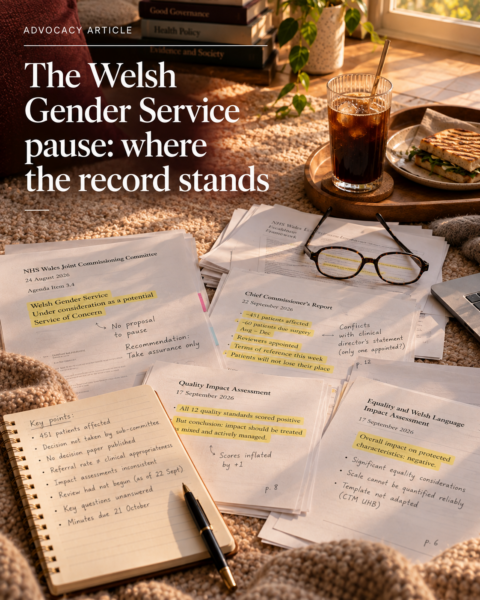
The Quality Impact Assessment lists twelve quality standards and scores six of them. Each scored row records a direction — positive, neutral or negative — a level of impact from one to three, and an impact score described in the form itself as “product of previous columns.”
Safe Care is scored positive at level 3. The product is 3. The form records 4.
Timely: positive, level 3, recorded as 4. Effective: positive, level 3, recorded as 4. Efficient: positive, level 3, recorded as 4. Equitable: positive, level 2, recorded as 3. Person-centred: positive, level 3, recorded as 4.
Every score is inflated by exactly one. This is not a rounding question or a matter of interpretation; the form states the arithmetic it is performing and then does not perform it.
Corrected, 10 October 2026: this section previously said the assessment “scores twelve quality standards”. It lists twelve, but only the six quality domains are scored; the six enabling standards record a level of activity only. The six rows above are all of the scored rows, so the finding that the arithmetic is wrong in every row stands. Further down, “every dimension” now reads “every scored standard”.
And the direction is wrong too
More significant than the arithmetic is what is being scored positive.
Under Timely, the assessment records that the pause “may increase psychological distress, uncertainty and mental health risk for some people” and “may also reduce confidence and trust in the WGS pathway and, more broadly, in NHS services, with a potential risk that some trans and non-binary people become less likely to seek healthcare when needed.”
That row is scored positive.
Under Equitable, it records “significant equality considerations”, differential impacts across age, disability, sex, ethnicity, pregnancy and maternity, sexual orientation, caring responsibilities and socio-economic circumstances, and that the scale of differential impact “cannot currently be quantified reliably.”
That row is scored positive.
The assessment’s own overall conclusion then contradicts its scoring: the quality impact “should therefore be treated as mixed and actively managed, rather than simply positive.” And the accompanying Equality and Welsh Language Impact Assessment reaches the opposite finding outright — “the overall impact identified from the pause itself on the protected characteristics is negative.”
So the commissioner holds two impact assessments of the same decision, published together, one scoring every scored standard positive and the other concluding the overall impact is negative.
I do not think this is dishonesty. I think the form has been completed by scoring the intended benefit of the review rather than the impact of the pause, which is what the form asks for. But the effect is a document whose scores cannot be read as meaning what they appear to mean, presented to a committee for assurance. (Note added 11 October 2026: the papers went to the Committee for noting, not for assurance; see the correction near the top.)
The equality assessment is on another health board’s template
The Equality and Welsh Language Impact Assessment is a Cwm Taf Morgannwg University Health Board form, and it has not been adapted. Section 4 asks the reader to consider whether the policy is relevant to “CTM UHB’s ambition for the use of Welsh.” Section 5 concerns ensuring “CTM UHB carries out its business in a way that promotes opportunities to use Welsh.” Support is directed twice to a Cwm Taf Morgannwg mailbox.
Cwm Taf Morgannwg hosts the Joint Commissioning Committee, so the template’s provenance is unremarkable. That it reached publication with another organisation’s name in the operative sections is less so.
The figures do not reconcile
Three documents give four different counts of the affected cohort.
Corrected, 10 October 2026: this previously said four documents. Three are named below, and between them they give four counts: 451, 450 to 500, around 100 with a surgical date this year, and approximately 60 due surgery by the end of December.
Cardiff and Vale, on 11 September, identified 451 patients across the pathway and wrote to all of them. The Quality Impact Assessment says “approximately 450–500 patients are potentially affected overall, of whom around 100 have a surgical date within the current year.” The Chief Commissioner’s Report says “approximately 60 patients were due surgery between the pausing of surgery in August and the end of December.”
The 60 and the 100 may be reconcilable — one is a period, the other a year. The 451 and the 450–500 are the same figure held to different precision. But a reader cannot tell which number governs, and the Quality Impact Assessment itself notes that “absolute patient numbers will be added alongside these percentages once verified”, which is an admission that the numbers carrying the argument are not yet verified.
The escalation box says both yes and no
The Quality, Safety and Outcomes Sub-Committee highlight report for 24 August carries the standard impact assessment block. The equality question records “Yes: ☒ No: ☒” — both boxes ticked. The outcome line beneath reads “Outcome for Equality (delete as appropriate): POSITIVE/NEUTRAL/NEGATIVE”, with the instruction and all three options left in place.
Trivial in itself. Less trivial as an indication of how much scrutiny these blocks receive, given that the same block on the paper that went to the Sub-Committee on 24 August is the basis for saying no equality screening was undertaken.
Corrected, 10 October 2026: this sentence could be read as though the highlight report and the paper that went to the Sub-Committee on 24 August were the same document. They are not. The highlight report is the Sub-Committee’s report of that meeting to the Joint Committee. The paper that went to the meeting itself is item 3.4, a separate document carrying the same template block.
The register entry is in the future tense
The Escalation Framework provides that, at Level 3, consideration will be given to entry on the risk register. The Joint Assurance Framework report published on 17 September records the Welsh Gender Service at Level 3 and states that the risk “is being developed internally and will be reflected within local directorate risk registers and within the Organisational Risk Register where relevant.”
Twenty-two days after escalation, the risk is not on the register.
Corrected, 10 October 2026: two things. The risk wording quoted above is in item 4.1.1, the strategic risks report published with the papers, not the Joint Assurance Framework report itself. And “the risk is not on the register” went further than the papers. The assurance framework describes the risk as still being developed. The register extracts published on 17 September predate the escalation, so they cannot show either way whether it has since been entered. The narrower point stands: as at 17 September the papers describe the risk in the future tense.
The same papers document how three other Level 3 escalations were handled. Salford Royal in January 2025: Commissioning Team recommendation, Senior Leadership Team endorsement, letter to the provider’s chief executive requesting an executive lead. Caswell Clinic in October 2025: Senior Leadership Team endorsement, letter to the health board executive team. The South Wales Specialist Auditory Implant Device Service in October 2025: Senior Leadership Team endorsement, formal escalation letter on 6 October, with the subsequent delay in confirming an executive lead recorded as a problem worth noting.
Three escalations, one route, a letter each time. For the Welsh Gender Service, no escalation letter, no nominated executive lead and no paper to the Corporate Directors Group appears anywhere in the published papers.
What I am not saying
These documents were written at speed. There are repeated misspellings of “patient”, a duplicated word in a key sentence about the complaints, and at least one sentence that stops mid-clause. I mention it once, as evidence of the conditions they were produced in, and not as a criticism. People wrote these under pressure and in a hurry.
Nor am I saying anything was fabricated or backdated. The assessments describe the decision in the past tense and make no claim to have preceded it. The Chief Commissioner’s report calls them documents “prepared in support of this work.” Nobody is pretending.
And I am not saying this was done to people deliberately. That claim is being made loudly at the moment and the documents refute it. The Equality and Welsh Language Impact Assessment records that the pause will cause distress and uncertainty; that it may reduce trust in the NHS to the point where some trans and non-binary people become less likely to seek healthcare at all; that people who have already spent money on travel and accommodation should be told about reimbursement; that carers and partners are affected too; and that patients who had surgery cancelled at very short notice will be reviewed first. The Quality Impact Assessment adds that communication “must avoid presuming that a referral was inappropriate before the clinical review establishes the facts.”
Corrected, 10 October 2026: this paragraph previously said patients whose surgery was cancelled at very short notice “should” be reviewed first; the equality assessment says they “will be reviewed first”. It also attributed the sentence about presuming a referral was inappropriate to the equality assessment. That sentence is in the Quality Impact Assessment.
And the equality assessment says this: “Mental health needs or neurodivergence should not in themselves be assumed to indicate that a patient is unsuitable to proceed; any decision must be based on individual clinical assessment and the relevant clinical criteria.”
Somebody wrote that sentence because they were worried it might happen. That is not the paperwork of people who are indifferent to harm. It is the paperwork of people who identified the harm in considerable detail and proceeded anyway, without having completed the assessment of necessity and proportionality that their own document lists as outstanding.
That is a worse finding than malice, and a more useful one. Malice would need villains. This needs a process that requires someone to write down why the proportionate response was not enough, before the disproportionate one is taken.
And I am not saying the pause is wrong. If the commissioner holds a specific documented concern that individual referrals were made without adequate clinical assessment, it may have been necessary. That question is for the clinical review.
What I am saying
The Committee meets on 22 September and is asked to take assurance from these papers.
Corrected, 10 October 2026: it was asked to note them, not to take assurance from them. See the correction near the top of this piece. This section is left as published.
The Quality Impact Assessment cannot support that assurance. Its arithmetic is wrong in every row, its directions contradict its own narrative, its conclusion contradicts its own scoring, and its companion document reaches the opposite finding. The equality assessment, which is the more careful of the two, records that the impact is negative, that the demographic data needed to assess disproportionate impact is not available, and that establishing the source of the complaints relied upon in the decision remains an action outstanding.
A commissioner may take an urgent decision on incomplete information. That is sometimes the right thing to do. What it cannot then do is present the reconstruction as assurance.
Corrected, 10 October 2026: the papers were not presented as assurance; they went to the Committee for noting (see the correction near the top). The point we would make now is narrower: a reconstruction written three weeks afterwards cannot stand as the reasoning for the decision. The sentence is left as published.
What I have asked
I have submitted four questions to the Committee for its meeting on 22 September, under the procedure published in its Committee Meeting Notice.
On what basis does a progression concern specific to masculinising genital surgery support pausing masculinising chest surgery and feminising genital surgery, where no comparable progression concern is identified?
Was any equality impact assessment undertaken before the service was placed in escalation on 26 August, and if so will it be published? If not, how did the Committee have due regard to the public sector equality duty at the time the decision was taken? Has an assessment of necessity and proportionality been completed at any point since?
What is the source, nature and number of the complaints relied upon in the decision, and what weight was placed on them?
Will the paper or advice on which the Sub-Committee’s decision of 24 August was based be published? Was a formal escalation letter issued to Cardiff and Vale University Health Board, and on what date? Who is the nominated Executive Lead?
I will publish the answers, or record their absence.
Update — 5 October 2026: recording their absence, and what has happened since
None of the four was answered as a distinct item. More than 160 public questions were consolidated into ten themes which the Committee said would be addressed during the meeting of 22 September. The chair named five of them at the start of the item and the meeting closed without returning to them. The account of that meeting is at What the Joint Committee said, and what it did not.
Three of our letters are now registered as statutory requests under the Freedom of Information Act: two referred there by the Committee, and one we submitted under the Act ourselves. Their deadlines fall around 23 and 28 October, subject to the question, set out on our correspondence page, of whether a request signed with a first name only is valid. The questions above now sit there.
Corrected, 10 October 2026: this previously said the Committee referred all three letters. It referred two; we submitted the third ourselves. The deadlines are now also stated subject to the name question.
On the two commitments in these documents, both still outstanding. The Quality Impact Assessment undertook that “absolute patient numbers will be added alongside these percentages once verified”; the Equality and Welsh Language Impact Assessment committed the Committee to “using absolute numbers alongside percentages where this improves understanding of impact and proportionality”. Neither has produced a number. The terms of reference published on 5 October give the masculinising genital progression rate as 34% where the Quality Impact Assessment gives 36%, with the first describing referrals and the second patients listed, and nothing published says which governs or what the denominator is.
And on the equality assessment specifically. The Equality and Welsh Language Impact Assessment lists, with the Joint Commissioning Committee named as responsible, an action to “undertake an equality assessment at the outset of the clinical review… and undertake a further equality assessment following completion of the review”. The Chief Commissioner’s report of the same date says the assessment “will guide the process as we proceed.” The terms of reference for that review, published on 5 October, contain no equality provision. We have asked whether the first assessment has been undertaken and whether both will be published.
Our reading of the terms of reference is at Clearer safeguards, figures that do not reconcile, and a screening method that needs explaining.
Eden Openly publishes at four layers: opinion, evidence notes, evidence reviews, and primary sources. This is an opinion piece. Every document referred to is published by the NHS Wales Joint Commissioning Committee and can be read in full on its website. We hold no privileged or leaked material and no case-level clinical detail.
Corrections: [email protected]