Welsh Gender Service — our coverage
- Our position — what was decided, what has not been shown, and what we ask
- What the published record shows — the running record, updated as the position changes, with full revision history
- The papers justifying the gender surgery pause do not hold up — the two impact assessments published on 17 September
- What the Joint Committee said, and what it did not — the meeting of 22 September, with a timestamp index to the recording
- The pause may be right. The process cannot show it — where this stands, stated as a view
- The terms of reference, read in full — the governing document of the review
- The published record, analysed — nineteen documents read against each other (seventeen at publication, two added since), every finding graded and independently checked
- Where the record stands — our view after the terms of reference, and eight things we ask (you are here)
- Our correspondence — every approach to a public body, what was asked, and where each stands
- Commitments made — what these bodies have promised, and whether it has been kept
NHS WALES · WELSH GENDER SERVICE · OPINION
This is an opinion piece. Its factual claims rest on the published record. Most are cited to our analysis of it by section number, as “Analysis §n”; the rest are cited to the primary document. Where we give a view, we say so. Published 6 October 2026 (UK time).
Our position
The pause may be justified. The published record does not show that it is.
In our view, the terms of reference for the independent review are the most careful document the NHS Wales Joint Commissioning Committee has published on this matter. They refuse to treat a high referral rate as proof of inappropriate referral, and they separate what was reasonable at the time from what is right now. We welcome that.
But the parts of the review that decide what happens to patients have not been published. People waiting to be referred are in no stage of the review, though it is the review that is to establish whether referrals can resume. In our view the published evidence for pausing all three procedures, for new and existing patients alike, is thin and inconsistent. And the record of the decision is not yet public. The Committee dates it to 24 August. A Joint Committee lay member has said it was scrutinised in a private session of the quality sub-committee, and the Committee Secretary has said those minutes will be published.
Our view is that the Committee should publish what is missing, close the gaps listed below, and publish a procedure-by-procedure review of whether a pause this wide remains proportionate. None of that requires anyone to accept or reject the concerns behind the pause. It only requires the process to be visible.
What the record supports
Some of the Committee’s case stands on its own figures, and we say so plainly.
- Referral rates from Wales are higher than from England. In 2025/26 the Welsh Gender Service made 403 referrals for surgery, against 1,803 from English services. Per head of population that is about 4.1 times the English rate. We recomputed every figure in the Committee’s table and it is correct (Analysis §3.1).
- Concerns were raised by people other than the Committee. The Chief Commissioner’s report records concerns from “NHSE clinical colleagues” about the appropriateness of referrals, “echoed in complaints and correspondence received from members of the public” (Chief Commissioner’s report, 22 September).
- The Committee’s framework provides for this level of escalation. Its Escalation Framework allows Level 3 where “a serious concern is identified”. Its papers record that admissions to another escalated service, Caswell Clinic, were suspended (Analysis §2.2).
- The scope was considered. At the Joint Committee on 22 September the Chief Commissioner said a narrower option, limiting the pause to people awaiting assessment, and a wider one were considered, and that “our clinicians advised us that the most appropriate decision, is the one that we have taken” (Analysis §2).
- Patients’ places have been promised orally. NWJCC reported an undertaking from surgeons that paused patients “will not have to go to the back of the queue” (Analysis §6).
- The terms of reference contain real safeguards. They say a high referral rate does not by itself establish inappropriate referral. They separate the original referral from current readiness. They warn that the absence of concerns in an initial sample “should not alone be treated as assurance regarding the wider service”, and require urgent concerns to be escalated without delay (Analysis §4.1).
A higher referral rate is a reasonable signal to investigate. The terms of reference treat it, together with the progression figure, clinical advisers’ concerns and complaints, as “a reasonable basis for further independent review” (terms of reference), and we agree.
What the record does not support
The published record does not show that referrals were inappropriate, that a pause of this width was needed, or how the review will decide anyone’s case.
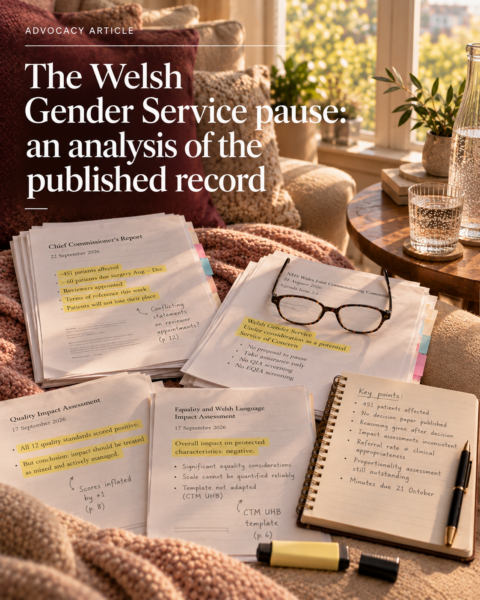
- The progression figures cannot bear the weight put on them. The terms of reference give 34% for masculinising genital surgery; the Quality Impact Assessment gives 36%. Neither gives a period, the number of patients, or what counts as proceeding. The patient numbers promised in September have not been published (Analysis §3.2).
- The rate gap and the progression concern point at different procedures. Masculinising genital surgery, where the progression concern lies, has the smallest referral-rate gap from England: 2.9 times. Feminising genital surgery has the largest, 4.8 times, and no document analyses it beyond one table. Different rankings do not by themselves undermine a combined rationale, but no document explains how they relate (Analysis §3.1).
- Masculinising chest surgery is paused with the rest. It is half of all referrals, and its referral rate is 4.1 times England’s. But the terms of reference record its progression rate, 97%, as “comparable” to England, and say a rate difference does not by itself establish inappropriate referral. They give a combined rationale for the pause as a whole and do not apply it procedure by procedure (Analysis §3.1, §3.2).
- There is no published finding of harm. The FAQs say “No immediate patient safety concerns have been identified by the NWJCC” and describe the pause as “a precautionary measure”. The Quality Impact Assessment calls the current information “a signal requiring investigation rather than proof of inappropriate referral” (FAQs; Quality Impact Assessment; Analysis §7.2).
- The decision record is not yet public. The public papers of the 24 August sub-committee meeting do not record the decision. A Joint Committee lay member has said it was scrutinised in the sub-committee’s private session, and the Committee Secretary has said those minutes and the paper will be published. Until then, the documents describe the decision in differing terms (Analysis §2).
- The review’s decisive rules are not published. That means the review framework, the “defined governance process” that reinstates, defers or removes patients, and the criteria for the interim review after 30 cases (Analysis §4.3).
Is the pause proportionate?
In our view, the published record does not show that a pause of this width is proportionate. It does not show that it is disproportionate either. The Chief Commissioner has said a narrower and a wider option were considered, and that clinicians advised the decision taken, but that advice is not published. The Committee holds information the public does not, which is exactly why it should publish enough to let others judge.
Our reasons:
- The pause is wider than the procedure-specific evidence. The documents give a combined rationale: referral rates higher for all three procedures, lower progression to masculinising genital surgery, clinical advisers’ concerns and complaints. The terms of reference say the rate difference “does not, in isolation, establish that either the Welsh or English referral threshold is clinically appropriate”. Neither the advisers’ concerns nor the complaints are published by procedure. That leaves the progression figure as the only published evidence pointing to a problem with one procedure, rather than a difference in rates. Yet the pause covers new referrals, assessments and surgery for all three. The terms of reference allow referrals or surgery to resume “for defined groups of patients”, but no document says which groups might qualify or when (terms of reference; Analysis §3).
- The Committee’s own papers set the test. The Quality Impact Assessment says the pause “carries material negative impacts for affected patients, including delay, distress, uncertainty and potential loss of trust”, names “mental health risk”, and says proportionality “should be kept under regular review”. The equality assessment commits to reviewing the pause regularly “to ensure it remains necessary, objectively justified, proportionate and time-limited”. No such review has been published. In our view, the interim review after 30 cases is one point at which it could be done (Quality Impact Assessment; equality assessment action plan; Analysis §6, §7.2).
- The delay falls hardest on those nearest surgery. About 450 to 500 people are potentially affected. The Quality Impact Assessment argues the effect on overall pathway efficiency is “limited”, because some waits are already up to about eight years and patients who are reassessed and found clinically appropriate return “in their original chronological position”. It also recognises that this “does not remove the potential impact on individual patients, particularly those who were closer to a planned surgical date”, which it says will be mitigated by prioritising them in the review. For them, every month of pause is still added delay (Quality Impact Assessment; Analysis §3.2, §3.3, §6).
- No end point has been set. The FAQs say “it is not possible to confirm when referrals may resume”. One answer ties restarting referrals to “any identified improvements” being addressed; the terms of reference instead separate actions needed before restart from longer-term improvements (FAQs; Analysis §7.2).
The Committee may be right to pause. If it is, publishing the basis, in a form that protects patients’ confidentiality, would cost it little and would answer most of what we raise.
What we ask
We ask the NHS Wales Joint Commissioning Committee to do these eight things. Each answers a specific gap in the record.
| # | We ask the Committee to | Because | Analysis |
|---|---|---|---|
| 1 | Publish the review framework, the “defined governance process” and the interim-review criteria before they are used on any patient | They decide who is reinstated, deferred or removed, and none is public | §4.3 |
| 2 | Say how people waiting to be referred will be assessed, and when | They are in no stage of the review, yet the review is to establish whether referrals can resume | §4.5 |
| 3 | Confirm that a flag on smoking or BMI alone will not lead to deferral or removal | NHS England specification 1780, the one that fits the terms of reference’s description, says referral “may still be made” in both cases | §5.2 |
| 4 | Commit to reviewing all of the roughly 60 people whose surgery was due by 31 December, or say what happens to those not reviewed | The terms of reference make the second 30 conditional; patients have been told their records “will be reviewed” | §4.4 |
| 5 | Publish the patient numbers behind the progression rates, and progression for feminising surgery | The numbers were promised in September; a feminising-surgery rate would show whether the concern is specific to one procedure | §3.2 |
| 6 | Publish the decision record: the minutes of the sub-committee’s private session, the paper before it, and the meeting that took the decision | The Committee Secretary has said the minutes and the paper will be published; the public papers of 24 August do not record the decision | §2 |
| 7 | Write into the review the commitments in the papers put to the Joint Committee: an equality assessment at the outset, protection of waiting-list position, and a role for patient groups and Llais | They appear in the impact assessments, or were given orally, but not in the terms of reference (updated 12 October 2026: Llais tells us it was invited to comment on the terms of reference before they were finalised, and was told people’s experiences will be considered as part of the wider service review; neither is a role in this review written into its terms) | §6 |
| 8 | Publish a dated, procedure-by-procedure review of whether the pause remains proportionate | Both impact assessments call for the pause’s proportionality to be kept under review, and no review has been published (QIA; EWLIA) | §6 |
We also ask Cardiff and Vale University Health Board to bring its FAQs into line with the terms of reference: on the consultation with NWJCC and surgical providers before decisions are taken, on when the pause ends, and on what the desk review can lead to (Analysis §7.2).
What would change our view
We would revise this view, and say so publicly, if any of the following were published.
- A decision record showing the paper considered, the body that decided and the evidence before it. The minutes of the sub-committee’s private session of 24 August are expected around 21 October, and the Committee Secretary has said they and “the paper shared” will be published. If they document the decision and its basis, we will say so.
- Absolute patient numbers showing that the masculinising genital surgery progression concern rests on a cohort large enough to support it, over a stated period.
- Case-level evidence of risk, even in summary, such as a number of referrals found by NHS England providers not to meet criteria, and on which criteria.
- The framework and governance process, if they protect the specification’s exceptions on smoking, BMI and hormones, and give every flagged patient a full assessment before any adverse decision.
- A procedure-by-procedure proportionality review that explains why each part of the pause is still needed.
If the evidence shows the pause was needed, we will say so.
What we are not saying
- We are not saying the pause was wrong. If the Committee holds documented evidence that referrals were made without adequate assessment, acting on it was right.
- We are not saying any referral was appropriate or inappropriate. We hold no case-level information, and the published documents do not allow anyone to judge.
- We are not saying the review will be applied unfairly. We are saying that the rules which would show whether it is fair are not published.
- We are not saying the sub-committee did not scrutinise or endorse the decision. A Joint Committee lay member has said it scrutinised the decision in private session, and the Chief Commissioner’s report says it endorsed it. We are saying that record is not yet published.
- We do not question the good faith of the clinicians reviewing patients, or of the Welsh Gender Service staff.
Our interests. Eden Openly is a party to this matter, not a neutral observer. We have written to the Committee (copying Cardiff and Vale University Health Board on our first letter), to Cardiff and Vale directly on 6 October (added 10 October 2026; this line previously omitted that letter), to Cwm Taf Morgannwg University Health Board, which handles information requests on its behalf, and to Llais, and we have made submissions to two Senedd committees. Our correspondence is published at edenopenly.com/wgs-correspondence. We hold no privileged information. Everything here rests on documents anyone can read.
Sources
This piece rests on our analysis of the published record, which grades each finding and gives every quotation with its source: The Welsh Gender Service pause: an analysis of the published record. Its section numbers are cited above as “Analysis §n”.
The primary documents:
- Terms of reference for the independent review, cover dated September 2026, published by Cardiff and Vale UHB on 5 October and by NWJCC on 6 October 2026
- Joint Committee papers, 22 September 2026: Chief Commissioner’s report, Quality Impact Assessment, Equality and Welsh Language Impact Assessment, QSOC highlight report with the Escalation Framework
- The public recording of the Joint Committee meeting of 22 September 2026 (our transcript from the automatic captions)
- QSOC papers, 24 August 2026
- NWJCC news: statements of 4 September (web address dated 3 September), 23 September and 6 October 2026
- Welsh Gender Service update FAQs, Cardiff and Vale University Health Board, as at 5 October 2026
- C&V update, 25 September 2026
- NHS England service specification 1780, Gender Identity Services for Adults (Surgical Interventions)
Eden Openly is an independent clinical health-education publication. It receives no funding from, and has no commercial relationship with, any provider of gender-related healthcare, any pharmaceutical company, or any supplier of NHS digital systems. Our full position is in our statement of independence. Corrections and queries: [email protected].