Welsh Gender Service — our coverage
- Our position — what was decided, what has not been shown, and what we ask
- What the published record shows — the running record, updated as the position changes, with full revision history
- The papers justifying the gender surgery pause do not hold up — the two impact assessments published on 17 September
- What the Joint Committee said, and what it did not — the meeting of 22 September, with a timestamp index to the recording
- The pause may be right. The process cannot show it — where this stands, stated as a view
- The terms of reference, read in full — the governing document of the review (you are here)
- The published record, analysed — nineteen documents read against each other (seventeen at publication, two added since), every finding graded and independently checked
- Where the record stands — our view after the terms of reference, and eight things we ask
- Our correspondence — every approach to a public body, what was asked, and where each stands
- Commitments made — what these bodies have promised, and whether it has been kept
Update — 6 October 2026
The Committee has published the terms of reference on its own website. A news item of 6 October states that it “has today published the Terms of Reference for the Independent Clinical Review relating to patients referred for gender affirming surgery through the Welsh Gender Service”, and links to the document under its Policies and Resources section. That is the commitment given in the progress update of 23 September and repeated by the health board on 25 September, and it is now met. We asked where the document would be published on the evening of 5 October; it appeared the following day. Section 6 below is written as at 5 October and is corrected accordingly.
And the same item repeats the Committee’s account of the decision. It states: “On 24 August 2026, NWJCC took the decision to pause referrals for gender affirming surgery from the Welsh Gender Service, assessments by surgical providers and new surgeries.”
Corrected later on 6 October: an earlier version of this panel called this a fourth account of the decision and the first time the Committee had said in its own words that it took it. Both were wrong. The same sentence appears word for word in the Committee’s progress update of 23 September, which we had read and cited; we did not check the new item against it before writing. Set against the record, the sentence does not close the question. The health board’s statement of 28 August said the decision “was made following a meeting of the NWJCC Quality, Safety and Outcomes Committee on 24 August 2026”. The Committee’s own statement of 4 September said that committee “considered the information and concluded” the service should be escalated. On 22 September the Committee Secretary said that body “isn’t a for[um] that’s made this decision”. The Chief Commissioner’s report records the sub-committee endorsing the recommendation on 24 August and the service being placed in escalation on 26 August.
So the Committee now says it decided on 24 August, which is the date of a meeting of a sub-committee that has been described as not having made the decision. The only body recorded as meeting that day is the one said not to have decided. Whether the Joint Committee itself took a decision on 24 August, and if so on what paper and by what route, is what the confirmed minutes due around 21 October should show.
Corrected, 6 October 2026: the last paragraph overstated the record. At the Joint Committee meeting of 22 September the Chief Commissioner said “We took the decision”, and a Joint Committee lay member said the matter had been scrutinised in a private (“in-committee”) session of the Quality, Safety and Outcomes Committee. We had the recording and missed both. What remains unpublished is the record itself: the paper, the record of the meeting that took the decision, and the advice before it. The Committee Secretary has said the minutes and the paper will be published around 21 October. The paragraph is left as published. Our full reading is in The published record, analysed.
The same item dates the first review cohort to surgery due “between 26 August 2026 and 31 December 2026”, so the decision date and the date from which patients were affected remain two days apart within a single document.
Corrected, 10 October 2026: we presented this as a discrepancy. It is not one. The Chief Commissioner’s report records the sub-committee endorsing the recommendation on 24 August and the service being escalated to Level 3 on 26 August. Two dates for two events. The terms of reference themselves date the pause to the same day: “the temporary pause on 26.08.26”. (Amended later on 10 October: an earlier version of this note said the pause took effect on 26 August and attributed that to the Chief Commissioner’s report, which gives no date for the pause. An interim version then removed the date altogether. The date is right, and its source is the terms of reference.) The sentence is left as published.
The two copies are the same file. The document on the Committee’s website and the one published by the health board on 5 October have the same MD5 checksum (9016C01548B6748C89DB0B173B8A2A00) and the same size, 708,046 bytes, and both match the copy we downloaded on 5 October. Nothing in the document changed between the two publications. An earlier version of this note said we could not confirm that; we since have.
Corrections and revisions — 5 October 2026
This piece was published on the evening of 5 October and substantially revised the same night, after three rounds of external review of the draft. The material changes are recorded here.
Removed. A calculation that 34% or 36% “of 53 referrals is eighteen or nineteen patients”, and the conclusion that the low-progression case turned on a difference of about one patient. Neither the Quality Impact Assessment nor the terms of reference states the denominator behind those percentages. We supplied one the documents do not give.
Corrected. We said the terms of reference “give no reason” for masculinising chest surgery remaining paused; they give a combined rationale for the pause as a whole, and what they do not do is apply it procedure by procedure. We described patients awaiting assessment as liable to removal “without being seen”, omitting stage 3b, which provides for assessment including a consultation. We wrote that nothing in the document is mandatory and that its safety provisions are therefore advisory; the count of modal verbs is right, the conclusion drawn from it was not. We said the standards the review will apply “do not exist yet”; the document provides for them to be agreed separately, and nothing published says whether that has happened. And we said the document carries no title block or date: it has both, on a cover page that is an image and so invisible to text extraction.
Withdrawn. An earlier version said the screening method contradicts the specification the review adopts. That goes beyond the evidence: the terms of reference say “applicable requirements” and route findings through a governance process, which could accommodate the specification’s exceptions. The narrower claim now made is that nothing published explains how the screen will preserve those distinctions.
Dates. Our letters to the Committee were sent on the evening of 5 October United Kingdom time, not 6 October. Corrected here and across our correspondence record, commitments tracker, running record and updates feed.
Smaller amendments: “equitable” appears once in the document and the concerns process provides for advocacy and reasonable adjustments, so equality is not wholly absent from it; the named specification is referred to three times, not four; the caution about low progression appears first in the Quality Impact Assessment of 17 September; a revision would be detectable by monitoring rather than undetectable; a claim about what a screen reader would announce is withdrawn pending testing; the referral ratios are calculated from the published counts rather than from rounded rates; and claims about what is absent from the Committee’s website are scoped to the pages we checked.
The terms of reference for the Independent Clinical Review of gender surgery referrals from the Welsh Gender Service were published on 5 October 2026. The document is dated September 2026, carries no version number and no approval record, and is available on the provider’s website; we did not find a link to it on the commissioner’s news page or its September meeting-papers page.
It is the most careful thing the NHS Wales Joint Commissioning Committee has published on this matter. It also gives a figure that does not match the one in the Committee’s own impact assessment published on 17 September, and it proposes a screening method for patients awaiting surgical assessment without specifying its operational criteria and safeguards.
Quotations and factual claims below are sourced to primary documents and attributed to the one they come from. Our interpretations are identified as ours.
1. What the document settles
Four things in it are better than anything published in August or September.
It instructs the review against the inference the announcements invited.
“The review should therefore examine possible explanations for the observed variation and should not assume in advance that higher referral activity necessarily represents inappropriate referral. It should consider differences in population need, case mix, referral criteria, assessment practice, patient preference, procedure type, changes in clinical circumstances during prolonged waits, data definitions and the operation of the respective pathways.”
“This difference does not, in isolation, establish that either the Welsh or English referral threshold is clinically appropriate.”
The second sentence declines to treat the English rate as the clinical benchmark. The caution is not new — the Quality Impact Assessment of 17 September already called the low progression figure “an outlier requiring further investigation” which “should not, at this stage, be treated as proof that patients have been referred inappropriately”. What is new is that it is now in the instructions the reviewers will work to.
It separates three questions that had been running together.
“A finding that a patient is not currently ready for surgery should not, without further evidence, be taken to mean that the original referral was inappropriate. Conversely, current readiness should not by itself provide assurance that the original assessment or governance process was adequate.”
Six opinion categories follow, including one for a referral that “did not meet one or more applicable requirements at the time, but the patient is now eligible and ready to proceed.” That structure helps guard against conflating documentation deficiencies with clinical inappropriateness, while leaving room for the cases where a deficiency is clinically significant.
It names its own sample for what it is.
“The absence of concerns in an initial convenience sample should not alone be treated as assurance regarding the wider service.”
And it sets a closure standard worth borrowing.
“Recommendations should not be regarded as complete solely because an action or revised document has been produced. Closure should require evidence that the change has been implemented and, where practicable, that it has improved the quality or reliability of the pathway.”
2. The figures do not reconcile
Ninety-seven per cent, “comparable” to England
“data from the GDNRSS suggests that although the rate of proceeding to masculinising chest surgery (MCS) for patients referred by the WGS at 97% is comparable to those referred by English gender services, NHSE advisors suggest that the rate of proceeding to masculinising genital surgery for WGS referrals at 34% is markedly different to those referred by English gender services (approximately 70-90%).”
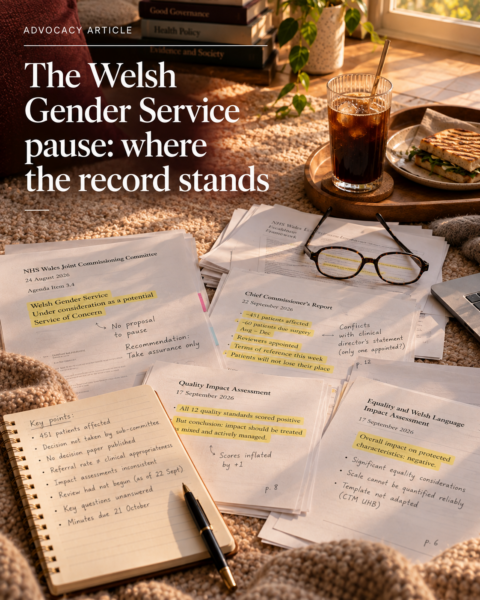
From the Chief Commissioner’s report to the meeting of 22 September, published on 17 September, masculinising chest surgery accounts for 201 of the 403 referrals in 2025-26 — half the total, and the largest of the three categories.
The document gives a combined rationale for maintaining the pause: referral activity, the progression figures, concerns raised by clinical advisers, information arising through complaints, and concerns about clinical governance. It concludes that “on balance” the safest option is to maintain it while the review establishes whether there is sufficient assurance to resume “either generally or for defined groups of patients.”
What it does not do is apply that rationale procedure by procedure. For the largest category it records the reported low-progression concern as not applying, and does not say what remains that requires those referrals to stay suspended rather than being among the “defined groups” for which assurance might come first. That is the question this piece is mainly about.
Thirty-six per cent, or thirty-four — and of what
The Quality Impact Assessment states that 97% of patients listed for masculinising chest surgery proceed to surgery, “compared with 36% of those listed for masculinising genital surgery.”
The terms of reference give “the rate of proceeding to masculinising genital surgery for WGS referrals” as 34%.
Two differences, not one. The figures differ, and so does the wording used to describe their denominators: patients listed in one document, referrals in the other. Listing and referral are not the same event and need not produce the same denominator. It is possible that the two documents are measuring different things and that the two-point difference is an artefact of that; it is equally possible that one figure supersedes the other. Nothing published says which.
The denominator is what the Quality Impact Assessment said would follow:
“Absolute patient numbers will be added alongside these percentages once verified, to support interpretation of scale and proportionality.”
The Equality and Welsh Language Impact Assessment, published the same day, commits the Committee to “using absolute numbers alongside percentages where this improves understanding of impact and proportionality.”
The documents we have examined do not supply the absolute numbers behind these progression percentages.
England, or England and Scotland
The Quality Impact Assessment says referral rates are “reported to be around 3–5 times higher than comparator areas in England and Scotland.”
The terms of reference say “significantly higher than from English gender services” and describe rates “3 – 5 times greater for Welsh patients compared to English patients.” The Chief Commissioner’s report compares the Welsh Gender Service with “Gender Identity Clinics in England” and tabulates 1,803 English referrals against a population of 58,620,100 — England alone.
Whatever Scottish comparison the Quality Impact Assessment refers to is not substantiated by the published table. A Scottish comparison may exist in analysis we have not seen; we found none in the documents examined.
The procedure carrying the concern has the smallest relative difference
Calculated from the referral counts and population denominators in the Chief Commissioner’s report, not from the rounded rates:
| Procedure | Welsh referrals | English referrals | Wales per 100k | England per 100k | Ratio |
|---|---|---|---|---|---|
| Masculinising chest | 201 | 904 | 6.31 | 1.54 | 4.09× |
| Feminising genital | 149 | 567 | 4.68 | 0.97 | 4.83× |
| Masculinising genital | 53 | 332 | 1.66 | 0.57 | 2.94× |
| All | 403 | 1,803 | 12.65 | 3.08 | 4.11× |
All within the “approximately three and five times higher” the Chief Commissioner’s report describes.
We checked the table rather than assuming it. The counts sum to the reported totals on both sides, and every percentage and per-100,000 figure is reproducible from the population denominators supplied. Those denominators — 3,186,600 for Wales and 58,620,100 for England — are not sourced or dated in the table.
Checking the arithmetic does not establish whether the populations and referral counts cover comparable groups, or whether the resulting rates measure comparable access through the two pathways. Nor does the ordering between procedures tell us anything independent: because the same two population figures divide every row, each ratio is simply the Welsh count over the English count multiplied by one constant, so the ranking is fixed by the counts alone. That is a property of the arithmetic, not evidence that national population is the right denominator.
Referral activity reflects throughput and access to the pathway; it is not a direct measure of population need, which is why the terms of reference are right to instruct the reviewers to consider “data definitions and the operation of the respective pathways” before drawing conclusions from it.
But the two limbs of the case point at different procedures. The largest relative referral difference is feminising genital surgery. The progression concern attaches to masculinising genital surgery, which has the smallest. A ratio does not by itself establish clinical or statistical strength, and different rankings on two measures are not in themselves evidence against a combined rationale. They do need explaining, and no published document explains how the two measures relate.
Feminising genital surgery is not discussed
149 of the 403 referrals — 37% of the total, the second-largest category, and on the table above the largest relative referral difference.
The word “feminising” does not appear anywhere in the terms of reference. We have found no procedure-specific progression figure for it in the documents examined, and no procedure-specific explanation is offered.
3. The screening method, and the standard it adopts
This is the part with the most direct consequence for patients who have not yet been assessed.
What is proposed
“A desktop review will identify patients who appear not to meet one or more basic clinical criteria, including applicable requirements relating to BMI, smoking or duration of hormone treatment.”
“Any apparent ineligibility, missing information or uncertainty should be referred through the defined governance process before a decision is made to defer or remove the patient from the surgical pathway.”
A stage 3b follows, providing for “assessment of patients as in Stage 1” — the full notes review and consultation. The document does not say who moves from 3a to 3b, on what criteria, or whether a patient will be seen before an adverse decision.
This work is not new. The Chief Commissioner reported on 17 September that “concurrently we are undertaking a desktop assessment of those awaiting surgical assessment to ensure that all basic eligibility criteria are met”, and noted the need for psychological support “particularly for those who may not be considered eligible for surgery.” Desktop assessment was therefore described as under way before these terms of reference were published. The relationship between that work and stage 3a, including the criteria already being used, needs explaining.
What the published specification says
The terms of reference name “the NHS England service specification” as their standard, without giving a number, a version or a date. The published specification for these services is Gender Identity Services for Adults (Surgical Interventions), service specification 1780. We have read it in full. On the three matters named in stage 3a it says this.
Smoking:
“For patients who smoke, a referral to a surgeon may still be made and an individualised discussion of risk and likely outcome included in the pre-operative counselling and consent process.”
Body mass index:
“patients with a BMI of 30 or more should lose weight before having genital surgery; and patients with a BMI of 40 or more should lose weight before having masculinising chest surgery. Referral to a surgeon may still be made and an individualised discussion of risk and likely outcome included in the pre-operative counselling and consent process.”
Hormone treatment. For masculinising chest surgery, among the criteria for initiation:
“Hormone therapy is not a pre-requisite”
and prior testosterone “is not a requirement and, in some cases, may be inconsistent with patients’ other goals for gender expression.”
For genital surgery:
“12 continuous months of hormone therapy as appropriate to the patient’s gender goals (unless the patient has a medical contraindication or is otherwise unable or unwilling to take hormones)”
What follows, and what does not
The specification does not support treating smoking, raised BMI or the absence of hormone treatment as automatic grounds for rejecting a referral. It expressly permits referral despite smoking or raised BMI, does not require hormone treatment for chest surgery, and qualifies the hormone requirement for genital surgery. A requirement with exceptions remains a requirement for the patients to whom it applies.
The terms of reference do not say the screen will apply automatic exclusions. They say “applicable requirements”, they distinguish apparent ineligibility from missing information from uncertainty, and they route all three through a governance process. That language could accommodate the specification’s distinctions.
What they do not do is explain how. Nothing published says how the screen will recognise that referral may properly have been made for a patient who smokes or whose BMI is raised, how it will avoid applying a hormone-duration criterion to chest surgery where none exists, how it will handle a patient who is “unable or unwilling” to take hormones, or how it will separate a referral that was valid when made from a patient’s readiness now. That operational detail should be published before screening findings are used to defer or remove anyone.
It matters because the same three factors run through the account of what went wrong. The health board’s FAQs define an inappropriate referral as “any referral that does not meet agreed clinical criteria or pathway requirements”, adding that “Factors including BMI, smoking status, unmanaged health conditions, and overall surgical fitness are considered before a patient is referred for surgery or before surgery proceeds” — and record cases “where NHS England providers have identified that referral criteria had not been met.”
So the question that follows is: when a referral was recorded as not meeting criteria, which criteria were applied, and were they these?
One limitation we should state ourselves
The specification sets materially different gates for the two masculinising procedures. Chest surgery requires one referral letter and no hormone prerequisite. Genital surgery ordinarily requires two letters — one from a professional “not directly involved in the individual’s care” — plus twelve continuous months of hormone therapy and twelve months living in the congruent gender role, each subject to the specification’s own qualifications and exceptions. Nor is the two-letter rule universal: a patient holding a Gender Recognition Certificate is “eligible for a referral for genital surgery subject to a single opinion from a Registered Medical Practitioner who has knowledge of the individual’s care plan, and on the basis of informed consent”.
Different gates could contribute to different progression rates, and that may bear on the 97% and 34% figures sitting side by side within Wales. It does not explain the comparison the Committee is actually making, which is between Welsh and English masculinising genital surgery. Differences between procedures cannot, without further evidence about implementation, patient mix or pathway operation, account for a difference between countries for the same procedure. We raise it as something the review’s own confounder list invites it to test, not as an answer.
4. What the review is bound by
Its operative standards are not in the published document
“Before case review work begins, the independent clinicians and the commissioner should agree a standard review framework, evidence requirements and definitions for eligibility, readiness, appropriateness, adequate assessment and insufficient information.”
“Before the interim review, the commissioner and independent clinicians should agree the criteria that would provide sufficient assurance to stop, extend or modify the review.”
Appropriateness is what the review exists to determine, and the document does not define it. Three sets of operative criteria — the framework, the definitions, the assurance thresholds — are provided for elsewhere, none published, none promised, with nothing published saying whether they have been settled while the review is described as under way.
Who will enforce the safeguards?
In ten pages, “must”, “shall” and “is required to” do not appear once. Almost everything is “should” — thirty-seven times — or “will”. The exceptions are two bare instructions on page 8, to identify material departures and to liaise with the Committee.
“Should” is not a synonym for optional; in professional standards it commonly marks a duty whose application depends on circumstances, and a convention from one body cannot be read into another’s commissioning document. The count does not settle the status of these provisions. What it leaves unclear is which are minimum requirements, who checks they have been met, and how a departure must be justified and recorded — for escalating an immediate risk to patient safety, for telling a patient why their surgery has been deferred, and for the route by which someone is removed from a pathway.
An interim decision after thirty assessments
“An interim review of outputs will be conducted in collaboration with the NWJCC and the NHSE surgical lead after 30 assessments to determine the need to assess the further 30 patients.”
“Stage 2 is dependent on the outcomes of stage 1. If assurance is gained after the review of 30 or 60 patients, stage 2 will not need to proceed.”
Stopping early is not a failure. If genuine assurance is obtained, continuing would put people through appointments they do not need. The questions are what then happens to the rest and on what evidence their pathways resume.
There is a plain difference between the document and what patients were told. Both bodies used the same word. The Committee’s progress update of 23 September says patients “waiting for surgery in 2027, and those who are waiting for a surgical assessment, will also have their referral reviewed to confirm that the requirements for surgery have been met”, and Cardiff and Vale’s statement of 25 September says the same. The terms of reference make it conditional.
The interim review does provide one opportunity to consider whether the pause remains proportionate — an action the equality assessment lists as outstanding, and which the Quality Impact Assessment says “should be kept under regular review”. (Corrected, 10 October 2026: this previously said both impact assessments list it as outstanding. Only the equality assessment does.) It is not the same exercise, since it reviews clinical assurance rather than the continuing restriction. It is the clearest specified assessment milestone at which that question could be addressed; the terms of reference do not set a separate timetable for reviewing the continuing pause.
Eight broad questions whose methods need clarifying
Page 9 asks the advisors to address safety, quality, effectiveness, psychological support, mental health, primary care, governance and service improvement — including “Is the current model clinically safe?” and “Are primary care arrangements sustainable and effective?”
Governance is properly in the remit; the document says the clinicians were engaged to examine “the associated clinical pathways and governance arrangements”. Page 8 provides for thematic analysis and for findings to inform the separate whole-service review. The structure is not absent.
What is absent is how questions of this breadth are answered from the evidence described. Clinical records may contain evidence relevant to primary care arrangements; they cannot establish sustainability across a service. And page 7 has already said a convenience sample cannot alone support a conclusion about the wider service.
The sharper question is which findings could justify continuing the pause. Page 8 requires recommendations to distinguish “actions required before referrals resume from longer-term service improvements”. That distinction is the safeguard, and nothing published explains how it will operate — or how the harm caused by continued delay will be weighed against the risk of proceeding.
There are now three reviews in this area: this one, the Welsh Gender Service Review, and, per the Chief Commissioner’s report, an NHS England review of gender surgery services expected to report in 2027. The terms of reference explain that this review will inform the wider Welsh Gender Service review. They do not explain how either will relate to NHS England’s review, or whether that review could affect decisions about restarting care.
5. The commitments the Committee made, and whether this document carries them
This is the part we got wrong in an earlier version, where we listed words the document does not contain. The better test is what the Committee committed itself to on 17 September, with named owners, in its own Equality and Welsh Language Impact Assessment.
That assessment concluded the overall equality impact of the pause is negative, with gender reassignment the protected characteristic most directly affected. It states that it “will remain live throughout the urgent clinical review”. Among its actions, with the Joint Commissioning Committee named as responsible:
“Undertake an equality assessment at the outset of the clinical review, using the available baseline cohort and protected-characteristic information, and undertake a further equality assessment following completion of the review. The post-review assessment should examine the outcomes of the review across protected-characteristic groups, including those who are considered appropriate to proceed and those who are not, to identify whether the review or resulting decisions have inadvertently or disproportionately adversely impacted any group.”
Also listed: establishing and maintaining an accurate cohort of people affected; analysing protected-characteristic and socio-economic data using absolute numbers alongside percentages; clarifying “the source, nature and number of complaints/concerns relied upon in decision-making, distinguishing affected patients from wider public or media concerns”; and reviewing the pause regularly “to ensure it remains necessary, objectively justified, proportionate and time-limited.”
The Chief Commissioner’s report of the same day says the assessment “will guide the process as we proceed.”
The terms of reference do not expressly incorporate the impact assessment’s commitments to baseline and post-review equality assessment, identify who will deliver them, or specify how the results will inform decisions. They do include an equitable-service aim and provision for advocacy, communication support and reasonable adjustments in the concerns process. Those safeguards matter, but they do not explain how the wider equality-monitoring commitments will be implemented.
We are not saying the commitments have been abandoned; the impact assessment is described as live and may be updated. We are saying the operative document for the review does not carry them, and that an equality assessment “at the outset of the clinical review” is time-limited by its own terms.
Four further things the document does not address:
Welsh. The back cover is bilingual; the eight pages of content are English only. Nothing provides for assessment in Welsh, where virtual consultation is the default.
Patient or lay involvement in design or oversight. None specified. Individual patients are consulted about their own cases, may seek reconsideration and may raise concerns, and the document is careful about each. Llais, which told us it had no role in the decision and was not given the scope, is not mentioned.
Updated, 12 October 2026: Llais has since told us that it was invited to comment on the terms of reference before they were finalised, which we did not know when this was written and which is to the Committee’s credit. It was sent them on 22 September, the day of the Joint Committee meeting, and submitted its comments the next day. It also told us it had asked for people’s experiences of the pause to be included, and had been told they will be considered as part of the wider review. The document itself still provides no patient or lay role in this review’s design or oversight. Llais’s reply is summarised on our correspondence page.
Selection of the reviewers, and conflicts. The document specifies “experienced independent gender clinicians” and no more: no number, no disciplines, no registration requirement, no detailed selection criteria and no conflicts-management arrangements. NHS England’s involvement does not of itself create a conflict, but its advisers raised part of the original concern, its specification is the standard, and its surgical lead sits on the interim review. On 22 September the Chief Commissioner said three reviewers had been appointed and the clinical director said one had been, with two being appointed.
Consent, information governance, indemnity, a reporting date, and publication. None appear. Independent clinicians from outside the service will read identifiable records and consult patients; no lawful basis or confidentiality arrangement is set out, which is a transparency gap rather than evidence of anything improper. No date is set by which the review reports — 31.12.26 appears only as the stage 1 cohort boundary — and there is no undertaking to publish the final report or respond publicly to its recommendations. The document asks that “the commissioners should confirm that the available clinical and administrative resource is sufficient”; nothing published records that they have.
6. The document, and where it is
The cover carries the Committee’s branding, the full title and the date September 2026; the back cover its address and contacts in English and Welsh. Both are full-page images, so neither appears in ordinary text extraction. Between them there is no version number, no author, no approval record and no review date, leaving a reader no visible version history against which to tell whether what they are reading has changed. We have put the file under monitoring.
The Committee’s progress update of 23 September said: “Following patient communications, the Terms of Reference for the independent review will be published on our website”. The health board’s statement of 25 September said they “will be published and made available on the NHS Wales Joint Commissioning Committee’s website.”
We did not find them there. As at the evening of 5 October the Committee’s news page carried nothing later than 23 September, and no link to the document; we checked that page and the Committee’s September 2026 papers folder, not the whole site. They are on the health board’s website, unlisted in the Welsh Gender Service navigation, absent from the frequently asked questions, and reachable from one sentence in one news item. Corrected 6 October: the following morning the Committee published the document on its own website, under Policies and Resources, and announced it in a news item. The commitment was met the day after we asked where it would be published, and this section should be read as describing the position on 5 October only.
We know how easy that is to miss, because we missed it. When the FAQs were rewritten on 5 October and the terms-of-reference question disappeared, we read the deletion as a commitment being dropped, said so on four pages, and put a question to the Committee that we withdrew within the hour. The full correction is in our commitments tracker.
7. What we have asked
Ten questions went to the Committee on the evening of 5 October, recorded in our correspondence record. A further five, arising from reading the specification and the two impact assessments, followed later the same evening: (corrected, 10 October 2026: a third letter, of three questions, also went that evening, and one of its questions was withdrawn within the hour. In all, eighteen questions went in four emails, and seventeen stand)
- Which service specification, and which version, do the terms of reference refer to, and which version applied at the date of the referrals under review?
- When a referral was recorded as not meeting criteria, which criteria were applied, and by whom — and how does that sit with the specification’s provision that referral may still be made for patients who smoke or whose BMI is raised?
- How will the stage 3a desktop screen give effect to the specification’s provisions that hormone treatment is not a prerequisite for chest surgery, that the genital-surgery criterion excepts patients unable or unwilling to take hormones, and that a patient holding a Gender Recognition Certificate is eligible for referral “subject to a single opinion”? And by what criteria will a patient move from stage 3a to the full assessment at stage 3b, given that stage 3a alone could result in a patient being deferred or removed without being seen? (As sent. The corrections panel above records that “without being seen” omitted stage 3b.)
- The Equality and Welsh Language Impact Assessment commits the Committee to an equality assessment “at the outset of the clinical review” and a further assessment after it. Has the first been undertaken, and will both be published?
- Do the 36% in the Quality Impact Assessment and the 34% in the terms of reference describe the same population — patients listed, or referrals made — and when will the absolute numbers promised on 17 September be published?
8. What we are not saying
We are not saying the pause was wrong. If the Committee holds a specific documented concern that individual referrals were made without adequate clinical assessment, acting on it was right, and this is a reasonable way to find out.
We are not saying the document is a bad one. Parts of it are better than anything else published in this matter.
We are not saying the screening method will be applied wrongly. We are saying nothing published explains how it will be applied, and that desktop assessment had already been reported as under way before these terms of reference were published.
We are not saying any patient was wrongly referred, or wrongly not referred. We hold no case-level information.
What we are saying is this. The evidential basis has been published in instalments that do not reconcile: two progression percentages whose cohort definitions and relationship have not been explained; a comparator set that includes Scotland in one document and not in another; and absolute numbers promised on 17 September, committed to again in the equality assessment, and still absent. The procedure carrying the progression concern has the smallest relative referral difference of the three. The second-largest category is not discussed at all. The detailed assessment framework, definitions and assurance thresholds are not included. The equality assessment the Committee committed to undertaking at the outset of the review appears nowhere in the review’s own terms. And it is not linked from the frequently asked questions or the service pages that patients were directed to use.
Cardiff and Vale put the number of people who may be affected at 451 in its material of early September (corrected, 10 October 2026: this said “affected”; its wording is “may be impacted”), and the Quality Impact Assessment estimated 450 to 500 potentially affected; we found no updated figure in the documents examined, and none of them says how many have since had an outcome. A better document about why is progress. It is not the same as a decision that has caught up with it.
Sources
- Terms of Reference, Independent Review of Referrals for Gender Affirming Surgery from the Welsh Gender Service, dated September 2026, published 5 October 2026 — Cardiff and Vale University Health Board
- Chief Commissioner’s Report, Agenda Item 2.3; Quality Impact Assessment, Item 2.3.1; Equality and Welsh Language Impact Assessment, Item 2.3.2 — NHS Wales Joint Commissioning Committee, papers for the meeting of 22 September 2026, published 17 September
- Progress update on the Welsh Gender Service surgical referral pause, 23 September 2026 — NHS Wales Joint Commissioning Committee
- Welsh Gender Service update, 25 September 2026 and 5 October 2026 — Cardiff and Vale University Health Board
- Welsh Gender Service Update FAQs — Cardiff and Vale University Health Board, as at 5 October 2026
- NHS England service specification 1780, Gender Identity Services for Adults (Surgical Interventions) — referral and pre-referral assessment at Appendix B, p.19; criteria for initiation of surgical treatments, including BMI, smoking and hormone provisions, at Appendix D, pp.21–22
Eden Openly publishes at four layers: opinion, evidence notes, evidence reviews, and primary sources. This is an opinion piece. It rests on the terms of reference published by Cardiff and Vale University Health Board on 5 October 2026; the NHS Wales Joint Commissioning Committee’s papers of 17 September (the Chief Commissioner’s report, the Quality Impact Assessment and the Equality and Welsh Language Impact Assessment), its statements of 4 and 23 September and its news page; the health board’s updates of 25 September and 5 October and its frequently asked questions; and NHS England service specification 1780, Gender Identity Services for Adults (Surgical Interventions), read in full. We hold no case-level clinical detail and no privileged information. We are a party to this matter, not a neutral observer.
Corrections: [email protected]