Corrections — 10 October 2026
A check of this piece against the primary documents and our other pages found the following. Each is marked where it occurs, with the original wording recorded.
- Only the equality assessment lists reviewing whether the pause remains “necessary, objectively justified, proportionate and time-limited”. We had said both impact assessments did.
- The health board did publish a statement on 25 September. We had said its news listing carried nothing after 11 September.
- Two leftover paragraphs that recorded the Committee’s 23 September statement “from secondary reporting” have been removed, because the primary text is given beside them.
- Our statutory deadlines are now stated subject to the open question about requests signed with a first name only.
- Notes now record the fourth description of the complaints, the Committee’s own publication of the terms of reference on 6 October, and what the 451 figure is.
- Also on 10 October, after review of the points we had marked for a ruling: “after ministers intervened” is corrected. The scope is now “never justified in public”. The paragraphs saying a proportionate alternative existed in August, and that a later equality assessment shows the duty was not discharged, carry notes saying they go further than the record and the law. And the line on reimbursement now uses the equality assessment’s own wording.
- Added later the same day: the three descriptions of the complaints come from two documents and the meeting, not three documents; and a note at the end records that the terms of reference came on 5 and 6 October, not “this week”, and make the review of the second 30 patients conditional.
The full list of corrections across our coverage is on our updates page.
Update — 5 October 2026
The terms of reference were published on 5 October 2026, ten days after the week in which they were promised, and on Cardiff and Vale University Health Board’s website rather than the Committee’s. (Updated, 10 October 2026: the Committee published them on its own website the next day, 6 October.) The panels below are left as published and should be read as the position at their dates.
On the question this piece puts at the end — what would end the pause — the document does not supply a criterion. It provides for the review framework, the definitions of eligibility, readiness, appropriateness, adequate assessment and insufficient information, and the thresholds that would justify stopping, extending or modifying the review, all to be agreed separately; none of those has been published. It does not name the reviewers or their number. It records masculinising chest surgery, half of all referrals, as progressing at a rate “comparable to those referred by English gender services”, which answers half the scope question raised above and leaves unanswered what keeps those referrals suspended. And it gives the masculinising genital progression rate as 34% where the Committee’s own Quality Impact Assessment gives 36% of a differently worded denominator.
Our reading of it in full is at Clearer safeguards, figures that do not reconcile, and a screening method that needs explaining, which also records the errors we published that evening and corrected the same night. (Corrected, 10 October 2026: this said “four errors”. That piece records more than four.)
Correction — 25 September 2026
We said we could not find the Committee’s statement on its website. That was wrong. The NHS Wales Joint Commissioning Committee has a news section at jcc.nhs.wales/news/, and both its statement of 4 September and its progress update of 23 September have been published there since the day each was issued. We searched the site, did not find the section, and told readers the Committee appears not to publish its statements. We should have found it. The error is ours.
Having now read both, three things in this piece are affected.
The 4 September statement names the surgery type. It records that for some forms of surgery, including masculinising genital surgery, a significantly lower proportion of Welsh patients progressed to surgery following referral than patients referred from English services. That was published on 4 September. At the Joint Committee meeting on 22 September the dropout rate was presented as a feature of the pathway, with no category named. The specificity was in the Committee’s own statement eighteen days earlier and did not survive into the room.
It also gives the fullest account of the concerns. Information from clinicians and correspondence received raised questions about whether aspects of the assessment process before referral had been completed appropriately, including whether some patients met the basic requirements for surgery such as body mass index and overall surgical fitness, and whether wider health needs had been fully considered. This is now the fourth description of the source of those concerns, after “members of the public”, “some patients” and “families of people going through this”.
And it states plainly who decided. The 4 September statement says the Quality, Safety and Outcomes Committee considered the information and concluded that the service should move to Level 3 escalation, with the pause and the review to follow. At the meeting on 22 September the Committee Secretary said that body “isn’t a for[um] that’s made this decision”. Both are the Committee’s own words, eighteen days apart.
The apology and the wider review scope, which we previously recorded from press reporting, are confirmed in the 23 September update and remain to the Committee’s credit. That update also says patients cleared by individual review will not wait for the wider review to finish before their surgery arrangements progress, and that patients awaiting surgery in 2027 and those awaiting assessment will have their referrals reviewed too.
Update — 25 September 2026
The terms of reference have not appeared. At the Joint Committee meeting on 22 September the Chief Commissioner said the terms of reference for the independent clinical review were agreed or in the final stages of agreement and would be published later that week. The Committee’s update of 23 September indicated instead that affected patients would be contacted once review arrangements were finalised, and that the terms of reference would then be published.
As at today they have not appeared on the Committee’s website or the health board’s. We have asked when and where they will be published.
This matters beyond the date. The terms of reference are where the review’s scope, its reviewers and the criteria for ending the pause would be set out. Until they exist in public, “if we have assurance on safety” remains the only stated condition for reinstatement, and it is not a criterion anyone outside the Committee can test.
Two of our requests are now statutory. On 25 September the Committee referred our follow-up of 23 September to Cwm Taf Morgannwg University Health Board, which handles information requests on its behalf, where it has been registered as a request under the Freedom of Information Act. We had asked for it to be treated as correspondence in the first instance. Since the eleven questions we put on 1 September remain unanswered after twenty-four days, we have resubmitted those under the Act as well. Both now carry a statutory deadline of twenty working days.
We would rather have had answers than deadlines. But a statutory request carries a right of internal review and referral to the Information Commissioner, which correspondence does not, and it requires the reasoning for any refusal to be stated.
Corrected, 10 October 2026: these deadlines and rights should have been stated subject to one question. The Freedom of Information Act requires a request to state the applicant’s name, which the Information Commissioner’s guidance reads as their real name, and our requests are signed with the author’s legal first name without a surname, so their validity is open. (Amended later on 10 October: this note first said we publish under “a name that is not a legal name”, which was wrong.) We raised this with the health board ourselves; it is set out on our correspondence page.
An apology, and confirmation that the terms of reference were still being finalised. The health board’s Welsh Gender Service FAQs were revised on 23 September. The section on where patients can find further information, which previously said only that patients would be updated as the work progressed, now reads in part: “The JCC is currently finalising the Terms of Reference for the Independent Review… We apologise sincerely for the upset this has caused to both individual patients and their families and people in the broader Trans community.”
That apology is unreserved and it is to the health board’s credit. It also confirms, from a primary source, that as at 23 September the terms of reference were still being finalised — the day after the Committee was told they were agreed or in the final stages of agreement and would be published later that week.
The health board did not publish a statement to accompany this. Its news listing carries nothing on the Welsh Gender Service after 11 September. The change was made by revising the FAQ page, which is dated but not announced.
Corrected, 10 October 2026: that was wrong. The health board published a Welsh Gender Service update on 25 September, and we missed it. The paragraph is left as published.
The Committee’s statement of 23 September. Published on its news page, and confirming what we had previously recorded from press reporting: an apology for the distress caused, acknowledging the uncertainty and worry experienced by patients and their families; that this remains a pause and not a permanent change; that patients awaiting surgery in 2027 and those awaiting a surgical assessment will also have their referrals reviewed; that confirmation has been sought from NHS England providers that patients able to proceed will be prioritised; and that no decisions about individual patient care have been made at this stage. It adds that the review will begin with patients whose surgery was due between August and December 2026, in order of planned surgery date, and that individual patients will have surgery reinstated as soon as their own review is complete rather than waiting until December.
Corrected, 10 October 2026: two paragraphs that stood here recorded the same statement again “from secondary reporting”, and said we would replace them with the primary text if it became available. The paragraph above already gives the primary text, from the Committee’s own update of 23 September, so the two leftover paragraphs, which repeated it attributed to press reporting, have been removed. The same defect was fixed on our commitments page on 27 September.
Welsh Gender Service — our coverage
- Our position — what was decided, what has not been shown, and what we ask
- What the published record shows — the running record, updated as the position changes, with full revision history
- The papers justifying the gender surgery pause do not hold up — the two impact assessments published on 17 September
- What the Joint Committee said, and what it did not — the meeting of 22 September, with a timestamp index to the recording
- The pause may be right. The process cannot show it — where this stands, stated as a view (you are here)
- The terms of reference, read in full — what the governing document settles, and what it leaves open
- The published record, analysed — nineteen documents read against each other (seventeen at publication, two added since), every finding graded and independently checked
- Where the record stands — our view after the terms of reference, and eight things we ask
- Our correspondence — every approach to a public body, what was asked, and where each stands
- Commitments made — what these bodies have promised, and whether it has been kept
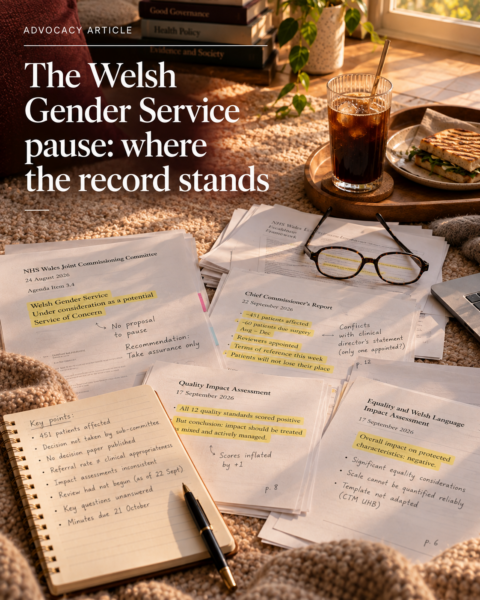
Twenty-eight days ago the NHS Wales Joint Commissioning Committee stopped gender affirming surgery for Welsh patients. Four hundred and fifty-one people are affected. (Updated, 10 October 2026: 451 is Cardiff and Vale’s count, of 11 September, of people who “may be impacted”. No later figure has been published.) Some learned that their operation was cancelled hours before it was due, after they had been admitted. As of the Committee’s meeting yesterday, the review the pause defers to had not begun.
This is what I think it adds up to, as of today. It is not a verdict. Two documents that would change it are due — the review’s terms of reference this week, and the confirmed minutes of the decision meeting on 21 October — and I will say so if they change it.
This piece states a view. The underlying record is set out in The Welsh Gender Service pause: what the published record shows, the two impact assessments in The papers justifying the gender surgery pause do not hold up, and the meeting itself in What the Joint Committee said, and what it did not.
What has been established
More than I expected, and it should be said first.
The referral-rate comparison is real and is now published with its numerator, denominator and comparator: 403 referrals from Wales against a population of 3.19 million, against 1,803 from England against 58.6 million. Roughly four times. Clinicians and surgeons working in the English service raised concerns about some Welsh referrals. Those are facts, not framing, and anyone arguing this was manufactured has to account for them.
The Committee has also done things that matter to patients. People cleared by the review will not lose their place in the queue and will not wait for every case to be reviewed before theirs proceeds. The equality assessment says people who have already spent money on travel and accommodation should be told about reimbursement. (Corrected, 10 October 2026: this said these costs “will be reimbursed”, which we have not been able to source.) The pause does not touch people mid-series, or needing treatment for complications, or aftercare. Psychological support is being provided through the gender service rather than the general mental health queue. A chief executive apologised to the patients involved.
And the equality assessment, when it came, was more careful than I anticipated. It concludes that the impact of the pause is negative. It warns that mental health needs or neurodivergence must not be assumed to indicate that a patient is unsuitable to proceed — a sentence nobody writes unless they are worried about it happening.
What has not
The scope has never been justified in public. The progression concern — that fewer Welsh patients proceed from referral to surgery — was presented to the Committee as a feature of the pathway. The Committee’s own Quality Impact Assessment, appended to the papers for that same meeting, disaggregates it: 97% of patients listed for masculinising chest surgery proceed, against 36% for masculinising genital surgery. Two hundred and one of the 403 referrals were for chest surgery; fifty-three for masculinising genital surgery. The concern belongs to the smallest category. Surgery was stopped for all three.
Corrected, 10 October 2026: the heading said the scope “has never been justified”. At the meeting of 22 September the Chief Commissioner said a narrower option, limiting the pause to people awaiting assessment, and a wider one were considered, and that “our clinicians advised us that the most appropriate decision, is the one that we have taken”. That advice is not published, so the scope has not been justified in public. The heading now says so. “Fifty-three for genital surgery” now reads “masculinising genital surgery”.
The evidence has not been characterised. The complaints relied upon have now been described three ways in three documents: members of the public, some patients, families of people going through this. (Corrected, 10 October 2026: “families of people going through this” was said at the meeting of 22 September and is not in a document, so these are two documents and the meeting.) The Committee’s own equality assessment lists, as an action still to be taken, clarifying their source, nature and number, “distinguishing affected patients from wider public or media concerns.” That action is still outstanding.
Updated, 10 October 2026: the 25 September correction above records a fourth description, from the Committee’s statement of 4 September: information from clinicians and correspondence received.
Necessity and proportionality have not been assessed. The equality assessment lists reviewing the pause to ensure it remains “necessary, objectively justified, proportionate and time-limited” as work still to be done, and the Quality Impact Assessment says “Proportionality should be kept under regular review”. That is the legal test for a measure of this kind. Twenty-eight days on, it appears in the future tense.
Corrected, 10 October 2026: this paragraph previously said both impact assessments list that action. Only the equality assessment does; the Quality Impact Assessment’s own wording is now quoted.
And nobody has said who decided. Every public account has pointed at the Quality, Safety and Outcomes Sub-Committee. At yesterday’s meeting the Committee Secretary said that body “isn’t a for[um] that’s made this decision”, that its role is to scrutinise and advise. No decision paper has been published. No escalation letter to the provider has been mentioned. No Executive Lead has been named. The risk arising from the escalation is recorded as “being developed” and “will be reflected” on the risk register.
Corrected, 6 October 2026: “nobody has said who decided” overstated the record. At the same meeting the Chief Commissioner said “We took the decision”, and a Joint Committee lay member said the matter had been scrutinised in a private (“in-committee”) session of the Quality, Safety and Outcomes Committee. We had the recording and missed both. What remains unpublished is the record itself: the paper, the record of the meeting that took the decision, and the advice before it. The Committee Secretary has said the minutes and the paper will be published around 21 October. The paragraph is left as published. Our full reading is in The published record, analysed.
The pattern
Set those against the dates. The service was placed in escalation on 26 August. The equality and quality impact assessments were created as files on 16 September and published on the 17th. The reasoning was given publicly on 4 September, the day the Health Minister, the Social Justice Minister and the Deputy First Minister met the Committee, as ITV Wales reported. (Corrected, 10 October 2026: this said “after ministers intervened”, which implies more than the record shows. Amended 11 October 2026: the source for the meeting is now named, and the Social Justice Minister, whom ITV Wales also reported as attending, is added. We have found no published record of that meeting other than press reporting, and the Welsh Government says it has no role in the escalation process (ATISN 27435, ATISN 27436).) The full referral data appeared on 17 September. The review had not begun as of 22 September.
The decision came first. The documentation followed, over three weeks, mostly under pressure.
That is not evidence of bad faith, and I want to be careful here because the opposite is being said loudly. Nothing was backdated; the assessments describe the decision in the past tense and make no claim to have preceded it. Nobody is pretending.
But it does mean something specific. Section 149 of the Equality Act requires due regard to the equality duty when a decision is taken, not afterwards. An assessment produced three weeks later is evidence that the duty was not discharged at the point it mattered. And a decision whose justification is assembled after the fact cannot demonstrate that it was proportionate when it was made — because nobody asked the question until later.
Corrected, 10 October 2026: this paragraph goes further than the law. Section 149 requires due regard when a decision is taken, but it does not require a written assessment at that point. So an assessment written three weeks later does not by itself show that the duty was not discharged. What it shows is that nothing written at the time has been published. Whether due regard was had in August is one of the things the decision record should show. The paragraph is left as published.
Added 11 October 2026: that note left out the Welsh specific duty. Regulation 8 of the Equality Act 2010 (Statutory Duties) (Wales) Regulations 2011 requires listed authorities to make arrangements for assessing the likely impact of their proposed policies and practices on their ability to comply with the general duty, and to publish reports of assessments that show a substantial impact. Whether an urgent pause counts as a proposed policy or practice, and how the regulation applies to a joint committee of health boards, are questions we cannot settle. But in Wales the law does say more about assessment than section 149 alone, so the absence of any published assessment from August is a sharper question than our note allowed.
Why this happens
I do not think anyone set out to harm these patients. I think something more ordinary occurred, and it is worth naming because it is fixable.
A commissioner receives a signal: referrals look high, some English clinicians have raised concerns, some complaints have come in. The signal is real but it does not identify a specific failure. Nothing in the pathway is mapped in a way that lets anyone say this control failed, here, and these patients are affected. So the available responses collapse into two: continue, or stop.
And the two are not symmetrical. If you continue and something later goes wrong, the question will be why you did not act. If you stop and nothing was wrong, the cost is criticism and a delay. Nobody is disciplined for pausing.
So you stop, and the paperwork catches up.
The Committee’s own remedy demonstrates the point. It is now running a desktop check on body mass index, smoking status and hormone criteria for patients awaiting surgery. Those are objective, checkable from records, and could have been audited across the waiting list without cancelling a single operation. The proportionate response existed. It is being used now. It was available in August.
Corrected, 10 October 2026: this paragraph states more than the record shows. The Chief Commissioner’s report describes the desktop check as covering “those awaiting surgical assessment”, not everyone awaiting surgery, and when it began is not clear. Whether a check of that kind would have been enough in August is the question the review exists to answer, and the published record does not show it either way. Our later view, in Where the record stands, is that the record shows neither that the pause was proportionate nor that it was not. The paragraph is left as published.
What we asked, and what came back
On 1 September I put eleven questions to the commissioner. No reply has been received. On 18 September I submitted four questions to the Joint Committee under its published procedure, alongside more than 160 from other members of the public. None of the four has been answered satisfactorily, and I set out below what each did and did not get, because “unanswered” would overstate it.
On why a progression concern specific to one surgery type justifies pausing three: nothing. The figure was presented to the Committee without disaggregation, and the disaggregated version in its own appendix was not mentioned.
On whether an equality impact assessment was undertaken before 26 August: nothing on timing. The assessments were described as live documents discussed at twice-weekly meetings, which is about their future use rather than their origin.
On the source, nature and number of the complaints: one clause — “families of people going through this”. That is a third characterisation rather than a clarification, and it supplies no number.
On the decision record: partially, and usefully. The minutes are dated to 21 October and the Committee Secretary confirmed the sub-committee did not take the decision (note, 11 October 2026: at the same meeting the Chief Commissioner said “We took the decision”; see the correction under “And nobody has said who decided” above). But no escalation letter, no Executive Lead and no decision paper.
I have written again asking whether written responses to the themed questions will be provided. That request is four days old at the time of writing and I would not expect a reply yet.
What would resolve this
Four things, none of them onerous.
The number and source of the complaints. Their own document says this needs clarifying; a count identifies nobody.
The decision record — which body decided, on what paper, on what date, with what advice. The minutes of 21 October should contain it.
An assessment of necessity and proportionality, published. The equality assessment lists it as outstanding, and the Quality Impact Assessment says proportionality should be kept under regular review. (Corrected, 10 October 2026: this previously said it is listed as outstanding in both.)
And the review’s terms of reference, promised this week, naming the reviewers, the criteria and what would end the pause. “If we have assurance on safety” is not a criterion. It is the absence of one, and it leaves the end of this entirely at the Committee’s discretion.
What patients are owed
Not this piece. The review, run properly and quickly, by the three reviewers the Chief Commissioner said had been appointed — or by the one the clinical director said had, which is a discrepancy that needs resolving before anything else.
Everything I have written here is about whether the decision can be shown to have been sound. For the 451 people waiting, that is second to whether their surgery happens. The Committee has said the reviews will be complete by the end of the year and that people will not lose their place. Those are the commitments that matter, and they are the ones I will be checking.
Updated, 10 October 2026: two things in this piece were overtaken. The terms of reference did not appear “this week”. The health board published them on 5 October and the Committee on 6 October. They also make the review of the second 30 of the roughly 60 patients conditional on an interim review after the first 30, so completion of all reviews by the end of the year is no longer a firm commitment. Where it stands is recorded on our commitments page.
Eden Openly publishes at four layers: opinion, evidence notes, evidence reviews, and primary sources. This is an opinion piece and it states a view. It rests entirely on documents published by the NHS Wales Joint Commissioning Committee and Cardiff and Vale University Health Board, and on the published recording of the meeting of 22 September 2026. We are a party to this, not a neutral observer. We hold no privileged or leaked material and no case-level clinical detail.
Corrections: [email protected]