Corrections — 10 October 2026
Three corrections and four smaller changes, each marked where it occurs. (Amended 11 October 2026: this panel previously said three changes, and did not list the four below.) This piece said the decision was attributed to a body which says it did not take it; at the same meeting the Chief Commissioner said “We took the decision”, and that correction, made on four of our other pages on 6 October, should have been made here too. The panel below presented 24 and 26 August as a discrepancy; they are the dates of two different events. And the account of what patients could rely on now carries a note on when the terms of reference actually appeared, and on what the 451 figure is. Also marked: that note was amended later the same day to use the terms of reference’s word “listed” rather than “due”; the Committee Secretary’s remark is now timed at about 39 minutes, not forty; and two lines were added to the timestamp index, for the Chief Commissioner’s “We took the decision” and a lay member’s reference to the in-committee meeting. The full list of corrections across our coverage is on our updates page.
Update — 25 September 2026
Two of the Committee’s own statements, which we had not read when this piece was written, bear directly on it. Both are on its news page at jcc.nhs.wales/news/, which we had wrongly reported we could not find.
The progression finding was specific, and published eighteen days before the meeting. The statement of 4 September records that for some forms of surgery, including masculinising genital surgery, a significantly lower proportion of Welsh patients progressed to surgery following referral than patients referred from English services. At the meeting on 22 September the dropout rate was given to the Committee as a feature of the pathway, with no category named. So the disaggregation was not only in the Quality Impact Assessment appended to those papers; it was in the Committee’s own public statement nearly three weeks earlier.
The reviewer count is partly resolved, and not in our favour. Llais, which attended the meeting, reported on 25 September that the Committee told the Board three independent clinical reviewers had been appointed and the terms of reference agreed. The Committee’s own update of 23 September says only that experienced gender clinicians have been appointed and final preparations are being completed; it gives no number. So the account that matches the Chief Commissioner is secondary and the primary source is silent on the figure. We record the contradiction as softened rather than settled, and we would rather say so than leave a finding standing that may not hold.
And the decision route is described twice, differently. The 4 September statement says the Quality, Safety and Outcomes Committee considered the information and concluded that the service should move to Level 3 escalation, that referrals, assessments and surgery should be paused, and that an urgent independent clinical review should be undertaken. At this meeting the Committee Secretary said that body “isn’t a for[um] that’s made this decision”. Both are the Committee’s own words, eighteen days apart.
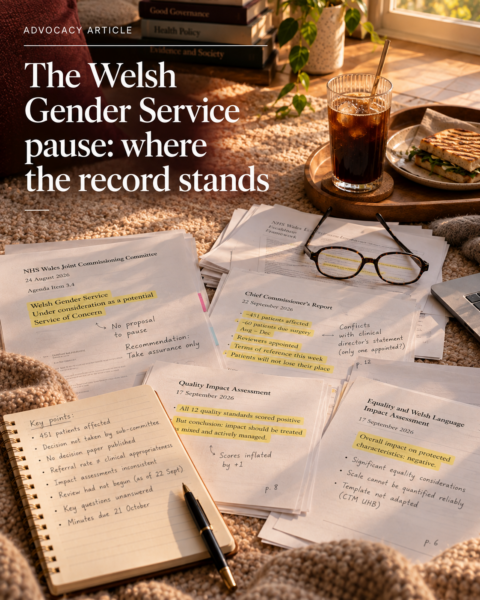
The 23 September update also gives the decision date as 24 August. The Chief Commissioner’s report says the service was placed in escalation on 26 August. Both dates come from the Committee.
Corrected, 10 October 2026: we presented these two dates as a discrepancy. They describe two different events. The Chief Commissioner’s report records the sub-committee endorsing the recommendation on 24 August and the service being escalated to Level 3 on 26 August.
Welsh Gender Service — our coverage
- Our position — what was decided, what has not been shown, and what we ask
- What the published record shows — the running record, updated as the position changes, with full revision history
- The papers justifying the gender surgery pause do not hold up — the two impact assessments published on 17 September
- What the Joint Committee said, and what it did not — the meeting of 22 September, with a timestamp index to the recording (you are here)
- The pause may be right. The process cannot show it — where this stands, stated as a view
- The terms of reference, read in full — what the governing document settles, and what it leaves open
- The published record, analysed — nineteen documents read against each other (seventeen at publication, two added since), every finding graded and independently checked
- Where the record stands — our view after the terms of reference, and eight things we ask
- Our correspondence — every approach to a public body, what was asked, and where each stands
- Commitments made — what these bodies have promised, and whether it has been kept
The NHS Wales Joint Commissioning Committee met on 22 September and spent the first three quarters of an hour on the Welsh Gender Service. More than 200 people watched. The recording is published, and everything below is taken from it.
Before anything else: the meeting produced more that patients can rely on than the previous four weeks put together.
Terms of reference for the independent clinical review would be published later that week. Reviewers had been appointed. The confirmed minutes of the 24 August sub-committee meeting will be published on 21 October, and the chair asked for that to be brought forward. There is a tiered plan for the 451 people affected — those whose surgery was paused this year come first, then those without a surgical date, then a desktop check on eligibility criteria for the rest. Patients cleared by the review will not go to the back of the queue, and will not have to wait for every case to be reviewed before theirs proceeds. A dedicated clinical lead has been brought in two days a week. The senior leadership team meets twice weekly on this. And a chief executive apologised to the patients involved.
Updated, 10 October 2026: this paragraph records what was said at the meeting. The terms of reference were not published that week. Cardiff and Vale published them on 5 October, and the Committee published them on its own website on 6 October, ten days after the week in which they were promised. They define the groups as patients listed for surgery between 26 August and 31 December 2026, then patients who will be listed for surgery after 31 December, then patients referred for surgery who are waiting for a surgical assessment, for whom the first step is a desktop review. (Amended later on 10 October: an earlier version of this note said “due” and “awaiting surgery”, where the terms of reference say “listed”.) 451 is Cardiff and Vale’s count, of 11 September, of people who may be affected. Our reading of the terms of reference is at Clearer safeguards, figures that do not reconcile, and a screening method that needs explaining.
I put four questions to the Committee under its published questions procedure. I am a party to this, not an observer, and what follows should be read accordingly.
This piece deals with the meeting. For the running account of the decision see The Welsh Gender Service pause: what the published record shows, for the two impact assessments see The papers justifying the gender surgery pause do not hold up, and for where we think this stands see The pause may be right. The process cannot show it.
Three reviewers, or one
At seventeen minutes, the Chief Commissioner told the Committee: “we have now appointed three reviewers who will undertake the review. Some psychologists and psychiatrists, all well-recognised, well-respected people within the gender affirming world.”
At twenty-nine minutes, the clinical director told the same meeting: “Potentially, we could start this week if we have a fair wind, but we’ve we’ve appointed one person. We’ve got two others being appointed.”
Both statements were made in public, twelve minutes apart, by the two officers closest to the work. The published Chief Commissioner’s report says “appointments to the independent clinical review panel have been made.”
One of these is wrong, and it matters, because the review is the thing the pause defers to. If three reviewers are in place, the work can begin. If one is, it cannot begin in the way described — the method the Chief Commissioner set out is that each reviewer considers a case and then all three come together, “so there is some objectivity and not just one person who’s looking at an individual.”
The sub-committee did not make the decision
The most consequential thing said all morning came from the Committee Secretary, about 39 minutes in (corrected, 10 October 2026: this said “forty minutes in”), answering a question about publishing the sub-committee’s minutes:
“the role of the Quality, Safety and Outcomes Committee is to scrutinise and advise decision making. That isn’t a for[um] that’s made this decision. It’s a decision that’s followed our established governance processes for escalation”
Every public account so far has pointed at the sub-committee. The health board’s statement of 28 August said the decision “was made following a meeting of the NWJCC Quality, Safety and Outcomes Committee on 24 August 2026”. The Chief Commissioner’s report says the sub-committee endorsed the recommendation and the proposals.
Endorsing is not deciding. So if the sub-committee scrutinised and advised, some other body decided. The Committee’s own escalation framework, and the three other Level 3 escalations documented in its papers — Salford Royal, Caswell Clinic and the South Wales Specialist Auditory Implant Device Service — all record the Senior Leadership Team endorsing escalation, followed by a letter to the provider’s chief executive.
No such letter has been mentioned for the Welsh Gender Service. No Executive Lead has been named. No decision paper has been published. The minutes due on 21 October may resolve this. Until they do, the decision that paused surgery for 451 people is attributed in public to a body which says it did not take it.
Corrected, 10 October 2026: that sentence overstated the record, and it should have been corrected on 6 October with the same passage on four of our other pages. At this meeting the Chief Commissioner said “We took the decision”, and a Joint Committee lay member said the matter had been scrutinised in a private (“in-committee”) session of the Quality, Safety and Outcomes Committee. We had the recording and missed both. The Welsh Government has since said the same in writing: its freedom of information answer of 28 September calls the escalation and the pause “clinical decisions made by the NHS Wales Joint Commissioning Committee”. What remains unpublished is the record itself: the paper, the record of the meeting that took the decision, and the advice before it. The paragraph is left as published. Our full reading is in The published record, analysed.
The figure that was not mentioned
The Chief Commissioner set out the evidence at twelve minutes. Referrals from Wales are “three to five times higher than they are in England”. Concerns were raised by clinicians and surgeons working in the English service. And: “there’s also evidence that our dropout rate was starting on the surgical pathway from Welsh patients is considerably higher than those from other parts of the United Kingdom.”
That last one was given as a finding about the pathway. No surgery type was named.
The Quality Impact Assessment published five days earlier, and appended to the papers for that meeting, says something more precise: 97% of patients listed for masculinising chest surgery proceed to surgery, against 36% of those listed for masculinising genital surgery. Of 403 referrals, 201 were for masculinising chest surgery and 53 for masculinising genital surgery.
So the low progression rate is not a feature of the pathway. It belongs to the smallest of the three categories. In the largest, almost everyone proceeds.
The same assessment describes the low figure as “an outlier requiring further investigation” which “should not, at this stage, be treated as proof that patients have been referred inappropriately”, and says the information “should be treated as a signal requiring investigation rather than proof of inappropriate referral.”
None of that reached the Committee. A member of the Committee then thanked the team for the “triangulation” of the evidence. Triangulation requires each leg to be characterised, and one of the legs was presented at a level of generality its own source document does not support.
Who complained
At thirteen minutes the Chief Commissioner said: “We also had complaints and concerns raised by families of people going through this.”
That is the third account of the same thing. The Chief Commissioner’s written report says the clinical concerns “have been echoed in complaints and correspondence received from members of the public”. The health board’s published FAQs say “concerns have been raised by some patients about the referral process”. Now, in the meeting: families of people going through this.
Families, patients and members of the public are three different groups, and the difference matters when the complaints form part of the stated basis for stopping treatment. The Committee’s own Equality and Welsh Language Impact Assessment lists, as an action still to be taken, to “clarify and accurately describe the source, nature and number of complaints/concerns relied upon in decision-making, distinguishing affected patients from wider public or media concerns.”
That action remains outstanding. A single clause in a meeting is not the clarification the document says is needed.
The questions
More than 160 questions were submitted by members of the public. The Committee published a document consolidating them into ten themes, which it said “will be addressed during the meeting”.
At nine minutes the chair named five of them — evidence and rationale, decision-making and accountability, proportionality, data quality and comparison, and support for individuals impacted — and said he hoped “we’ll be in a position to cover those key areas off during the course of this item.”
Some of it was. Support for individuals was covered at length and with evident care. Proportionality and the route back to treatment were addressed directly. Data quality was raised, though the figures discussed were not the ones in the appendices.
Five themes were not named and, as far as I can tell, were not reached: clinical advice and the independent review’s methodology; equality, dignity and patient harm; patient and stakeholder involvement; transparency, communication and publication; and whether political or external influence bore on the decision, and whether the same governance threshold would apply to other NHS surgical pathways.
The meeting closed without returning to them. The Committee’s own document contemplates this — questions may be “deemed to have been answered through those proceedings” — so nothing improper happened. But theme 9 records that correspondents asked for the “provision of clear written answers”, and those have not yet been provided. I have written to ask whether they will be.
What is not in dispute
The Committee is entitled to act on a precautionary basis. The chair said the decisions “are based upon clinical decisions and in relation to clinical governance and assessment of harm”, and that he wants the pause “lifted as quickly as possible so that people can return to their gender affirming journey”. He disclosed his own long involvement in LGBTQ+ health advocacy. Nobody at that table was indifferent.
If the review finds that referrals were made without adequate assessment, the pause will have been right and most of what I have written here will be a procedural quibble about a decision that was substantively correct. That remains possible and I would rather find it out than be right about the paperwork.
But the account given to the Committee was less precise than the account in the Committee’s own papers. The progression finding was generalised beyond what its source supports. The complaints were characterised a third way. And the body everyone believes took the decision says it did not.
Corrected, 10 October 2026: the Chief Commissioner said at the same meeting that the Committee took the decision. See the correction under “The sub-committee did not make the decision” above.
Those are not matters for the clinical review. They are matters for the minutes of 21 October.
Where to find this in the recording
The meeting is published in full at youtu.be/lJxJmQeLpeQ. Timestamps are approximate to within a few seconds. We have not published a transcript: the automatic transcription we worked from garbles names and occasionally repeats lines, and putting words into named officials’ mouths under our own masthead is not something we are willing to do. The recording is the source, and anyone can check any quotation here against it.
- 1:17 — Chair: a meeting held in public, not a public meeting; questions received from members of the public
- 9:05 — Moving to the Chief Commissioner’s report; “hopefully, many of these will be addressed during the course of the next half an hour or so”
- 9:36 — Five themes named; “hopefully we’ll be in a position to cover those key areas off during the course of this item”
- 10:06 — Chair’s disclosure of long involvement in LGBTQ+ health advocacy
- 10:36 — “The decisions that we have taken are based upon clinical decisions and in relation to clinical governance and assessment of harm”; pause to be lifted as quickly as possible
- 12:37 — The Gender Dysphoria National Referral Support Service; referrals from Wales “three to five times higher than they are in England”
- 12:57 — “We didn’t just act on that information”; concerns raised by clinicians and surgeons in the English service
- 13:20 — “We also had complaints and concerns raised by families of people going through this”
- 13:28 — Dropout rate on the surgical pathway “considerably higher” — stated without disaggregation by surgery type
- 14:47 — The decision: pause surgery, pause surgical assessments, commission an urgent independent clinical review
- 14:50 — Chief Commissioner: “We took the decision to pause gender affirming surgery and to pause assessments for surgery and also to undertake an independent and urgent independent clinical review” (added 10 October 2026)
- 15:07 — Services continuing: psychological support, hormone therapy, speech and language therapy; referrals into the service continue
- 17:17 — “we have now appointed three reviewers who will undertake the review… psychologists and psychiatrists, all well-recognised, well-respected people within the gender affirming world”
- 17:33 — Terms of reference “agreed or in the final stages of agreeing”; “published later this week”
- 17:40 — Review method: case notes, then consultation with the patient, then all three reviewers consider each case together
- 19:30 — “absolutely imperative that we are guided by our equalities impact assessment”; “these are live documents”
- 21:22 — “this is a decision made on safety grounds”
- 21:48 — Llais invited to speak
- 22:55 — Llais sets out five concerns raised with it by patients
- 24:49 — Cardiff and Vale on support, communication and triage
- 26:18 — The three groups and the order of review; patients will not go to the back of the queue
- 28:18 — “If we have assurance on safety, I think it’s completely different if we don’t have assurance on safety”
- 28:50 — Chair on timescales; terms of reference “near to being finalised”
- 29:19 — “we could start this week if we have a fair wind, but we’ve we’ve appointed one person. We’ve got two others being appointed”
- 31:37 — Lay member: if the review finds some referrals were not appropriate, what support will those patients have
- 32:29 — Lay member on triangulation of the evidence base
- 33:25 — Chief executive of Swansea Bay: “I think it’s important to apologise to the patients involved”
- 34:12 — Confirmation that cases will not wait for the whole review before proceeding
- 35:52 — Lay member on “the level of detail and scrutiny that took place in the in-committee meeting” of the Quality, Safety and Outcomes Committee (added 10 October 2026)
- 37:24 — Question from the chat: will a patient cleared by the review go straight back on the list
- 38:13 — Committee Secretary on publication of the sub-committee’s minutes and papers
- 38:49 — “the role of the Quality, Safety and Outcomes Committee is to scrutinise and advise decision making. That isn’t a for[um] that’s made this decision”
- 39:11 — Minutes anticipated 21 October; chair asks whether this can be expedited
- 41:38 — The wider Welsh Gender Service review; initial report by December
- 43:27 — Additional governance: senior leadership team meeting twice a week; equality and quality impact assessments discussed there; a dedicated clinical lead two days a week
- 45:16 — Two mechanisms for the equality assessment: protected characteristics, and statistical analysis of outcomes using anonymised data
- 2:24:52 — Chair’s closing remarks; an in-committee meeting had been held earlier that morning
- 2:26:02 — Peak attendance 206
Eden Openly publishes at four layers: opinion, evidence notes, evidence reviews, and primary sources. This is an opinion piece. Every quotation is taken from the published recording of the meeting of 22 September 2026 and checked against it. Every document referred to is published by the NHS Wales Joint Commissioning Committee or Cardiff and Vale University Health Board. We hold no privileged or leaked material and no case-level clinical detail.
Corrections: [email protected]