TL;DR
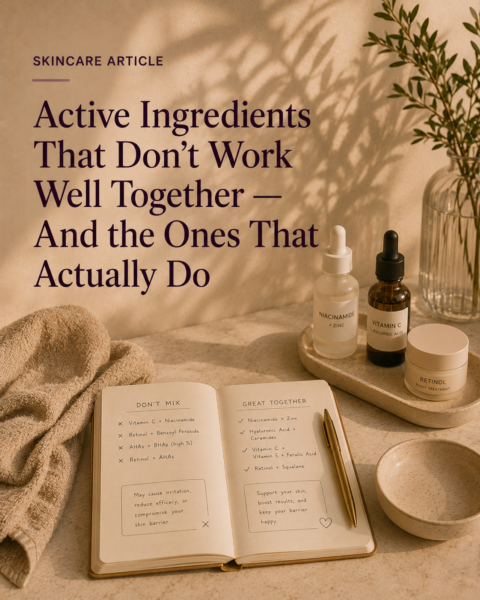
- The concern about combining niacinamide and vitamin C is based on outdated chemistry that does not replicate real-world skin use
- The theoretical problem requires conditions — high temperatures, high concentrations, extended contact time — that do not occur in normal skincare application
- At typical skincare concentrations, there is no clinical evidence of meaningful harm from combining them
- Niacinamide may improve tolerability and complements several of vitamin C’s effects through different mechanisms — they do not need to be separated
- Many well-regarded formulations deliberately combine them — the “can’t mix” warning is a skincare myth
Few ingredient combination warnings have been repeated as confidently as the niacinamide-vitamin C concern. It is also one of the most outdated. Niacinamide and vitamin C do not need to be separated.
Where the concern came from
The theoretical problem is that niacinamide and L-ascorbic acid (vitamin C) can react to form nicotinic acid — niacin — which can cause skin flushing. This was demonstrated in vitro: in laboratory conditions, the reaction does occur. The concern entered skincare advice and became repeated across blogs, videos, and product recommendations as though it were an established clinical finding, rather than a chemistry result observed under specific test-tube conditions.
The critical detail that was largely dropped along the way: the reaction requires high temperatures, high concentrations, and extended contact time. None of these conditions apply in normal skincare use. At room temperature, at the concentrations found in skincare products, and in the brief contact time between application and absorption, the reaction does not occur at meaningful levels — not that it cannot occur under any circumstances, but that the circumstances required don’t exist on your face.
What the evidence actually shows
There is no clinical evidence that combining niacinamide and vitamin C at typical skincare concentrations causes skin flushing or any other meaningful adverse effect. The combination is used in commercially available products without the problems the original theory predicted. Many reputable formulations deliberately combine both ingredients, which would be an unusual choice if the old concern held up in practice.
Niacinamide may improve tolerability of vitamin C formulations, though the clinical evidence for this specific effect is still emerging rather than firmly established. The two ingredients work through different mechanisms toward some overlapping practical outcomes: niacinamide inhibits melanosome transfer (the process by which pigment moves from melanocytes to surrounding skin cells), while vitamin C interferes with melanogenesis (pigment production itself). Different pathways, similar practical benefit for pigmentation concerns.
It’s worth being precise about what niacinamide actually does, since it is sometimes described loosely as an antioxidant alongside vitamin C. Niacinamide is not a classical antioxidant in the same sense vitamin C is. Its primary actions include increasing ceramide synthesis, supporting barrier function, influencing pigmentation pathways, and affecting cellular NAD+ metabolism. Vitamin C’s antioxidant activity — direct free radical scavenging — is a different mechanism. The two ingredients are complementary because they do different useful things, not because they perform the same antioxidant function in parallel.
What this means in practice
The evidence supports compatibility and complementary mechanisms. It does not establish that combining the two ingredients produces results superior to using either separately — that would be a stronger claim than the current research supports. What the evidence does support is straightforward: there is no reason to avoid using both, and reasonable grounds to expect they work well together rather than against each other.
Modern vitamin C formulations are also considerably better stabilised than early preparations, often combined with ferulic acid, vitamin E, or encapsulation technology that improves stability and reduces irritation potential generally — further reducing the relevance of compatibility concerns that originated with much older, less sophisticated formulations.
What the myth cost
The persistence of this warning has led people to either avoid combining two genuinely useful ingredients, use them at inconvenient separate times, or purchase separate products they could have combined. It is a useful example of how skincare advice can calcify around an outdated finding and resist correction even as better evidence accumulates.
⚠️ Clinical note: The evidence supports that niacinamide and vitamin C are compatible and may offer complementary benefits through different mechanisms. It does not establish that combining them produces synergistic results superior to using either alone — that is a stronger claim than current research supports.
Sources
- Hakozaki T, Minwalla L, Zhuang J, et al. The effect of niacinamide on reducing cutaneous pigmentation and suppression of melanosome transfer. Br J Dermatol. 2002;147(1):20–31. doi:10.1046/j.1365-2133.2002.04834.x [35–68% inhibition of melanosome transfer; no effect on tyrosinase activity — confirming niacinamide’s mechanism is melanosome transfer, not melanogenesis.]
- Greatens AL, Hakozaki T, Koshoffer A, Epstein H, Schwemberger S, Babcock G. Effective inhibition of melanosome transfer to keratinocytes by lectins and niacinamide is reversible. Exp Dermatol. 2005;14(7):498–508. doi:10.1111/j.0906-6705.2005.00309.x
- Tanno O, Ota Y, Kitamura N, Katsube T, Inoue S. Nicotinamide increases biosynthesis of ceramides as well as other stratum corneum lipids to improve the epidermal permeability barrier. Br J Dermatol. 2000;143(3):524–531. doi:10.1046/j.1365-2133.2000.03705.x [Ceramide biosynthesis increased 4.1–5.5-fold by niacinamide in keratinocyte cultures.]
- Boo YC. Mechanistic Basis and Clinical Evidence for the Applications of Nicotinamide (Niacinamide) to Control Skin Aging and Pigmentation. Antioxidants (Basel). 2021;10(8):1315. doi:10.3390/antiox10081315 [Comprehensive review of niacinamide mechanisms including NAD+ restoration, ceramide synthesis, and melanosome transfer inhibition.]
- Telang PS. Vitamin C in dermatology. Indian Dermatol Online J. 2013;4(2):143–146. doi:10.4103/2229-5178.110593 [Vitamin C’s antioxidant mechanism: direct free radical scavenging; melanogenesis inhibition via tyrosinase.]
- Farris PK. Topical vitamin C: a useful agent for treating photoaging and other dermatologic conditions. Dermatol Surg. 2005;31(7 Pt 2):814–817. doi:10.1097/00042728-200507000-00003 [Tyrosinase inhibition as vitamin C mechanism for melanogenesis.]
- Cosmetic Ingredient Review Expert Panel. Safety Assessment of Niacinamide and Niacin as Used in Cosmetics. Int J Toxicol. 2005;24 Suppl 5:1–31. [Safety review; flushing requires high concentrations not found in topical formulations.]
- Pullar JM, Carr AC, Vissers MCM. The Roles of Vitamin C in Skin Health. Nutrients. 2017;9(8):866. doi:10.3390/nu9080866 [Ferulic acid and vitamin E stabilisation of vitamin C formulations.]