TL;DR
- Most ingredient combination warnings are overstated or based on outdated evidence — the actually problematic combinations are fewer than social media suggests
- Traditional tretinoin can be oxidised by benzoyl peroxide, but modern stabilised formulations are specifically designed to allow concurrent use
- AHAs/BHAs and retinoids together is not a chemical incompatibility — it is an irritation and barrier disruption issue, and many experienced users tolerate same-night use
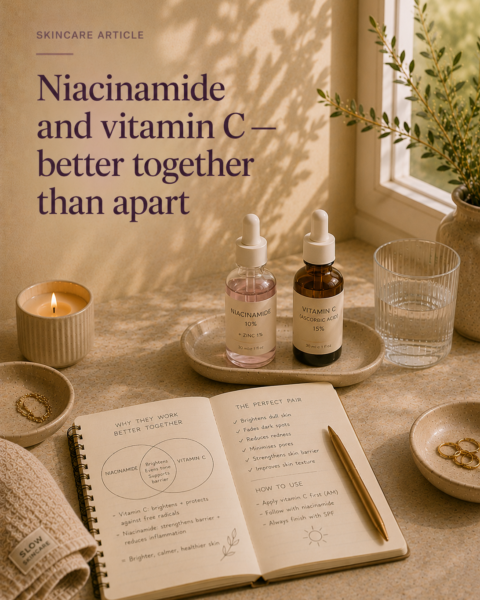
- Niacinamide and vitamin C together is not a problem in modern formulations — the outdated concern relied on conditions that don’t exist in real skincare use
- Most incompatibilities in skincare are problems of irritation, not chemistry
The skincare internet is full of ingredient combination warnings. Most of them are either wrong, outdated, or based on theoretical chemistry that doesn’t translate to real-world skin use. The genuinely problematic combinations are fewer and more specific than the lists circulating online — and most incompatibilities in skincare are problems of irritation, not chemistry.
The genuine interactions
Benzoyl peroxide and traditional tretinoin: Traditional tretinoin formulations can be oxidised by benzoyl peroxide, meaningfully reducing activity. This is a real, well-established pharmacological interaction. However, modern stabilised formulations — including microsphere tretinoin and combination products specifically engineered for this purpose — are designed to allow concurrent use without the oxidation problem. If you are using an older or generic tretinoin formulation alongside benzoyl peroxide, applying them at different times remains the safer approach; if you are using a product specifically formulated for combined use, this concern does not apply.
Notably, not all retinoids share this vulnerability. Adapalene is photostable and oxidation-resistant, which is why one of the most successful and widely prescribed acne combination products pairs adapalene with benzoyl peroxide directly in the same formulation. Tretinoin’s sensitivity to benzoyl peroxide is not a universal retinoid property.
AHAs/BHAs and retinoids on the same application: Not a chemical incompatibility — the issue is additive irritation and barrier disruption. Both categories promote epidermal renewal through different mechanisms: retinoids via nuclear receptor activation and altered gene transcription, AHAs/BHAs via accelerated desquamation. Using both on the same night, particularly when starting either, compounds irritation risk without meaningfully increasing benefit over alternating nights. Many experienced users with well-adapted skin tolerate same-night use without difficulty once both are established individually.
Two exfoliants in the same session: Using multiple AHAs together, or combining glycolic and lactic acid, often provides little additional benefit and adds irritation risk. AHA and BHA combinations are a partial exception — they are sometimes intentionally used together because they work in different compartments: AHAs act more on the epidermal surface, while salicylic acid is lipophilic and penetrates into the follicle, making the combination useful for specific concerns such as acne and comedones. Combining exfoliants is often unnecessary unless targeting a specific concern that benefits from both mechanisms.
The exaggerated warnings
Niacinamide and vitamin C: The concern about combining these stems from older laboratory experiments involving high heat, high concentrations, and prolonged incubation — conditions that do not replicate normal skincare use. At typical skincare concentrations and standard application, this combination is not problematic and is used routinely in well-regarded modern formulations. Niacinamide may improve the tolerability of vitamin C formulations, though the clinical evidence for this is still limited rather than firmly established.
Vitamin C and retinoids: The concern that low-pH vitamin C might degrade retinol over extended contact is largely theoretical and has limited clinical relevance in normal use. Morning vitamin C and evening retinoid remains the conventional approach, but same-session use is not inherently problematic either.
Vitamin C and copper peptides: Another frequently repeated warning with weak supporting evidence. The theoretical concern is that copper can destabilise vitamin C — and unlike the niacinamide case, copper-catalysed oxidation of ascorbic acid does have a real chemical basis. What has not been demonstrated is whether this matters clinically at typical formulation concentrations and real-world use conditions. Separating the two by time of day is a reasonable and low-cost precaution, but the evidence for meaningful incompatibility in practice remains thin.
Most other “can’t mix” combinations circulating on social media are either unsubstantiated or based on in-vitro chemistry that doesn’t reflect real skin conditions. The skin is not a test tube.
⚠️ Clinical note: Formulation matters considerably for these interactions — modern stabilised products are often specifically engineered to avoid older compatibility problems. When in doubt about a specific product combination, checking whether the formulation was designed for concurrent use is more informative than generic ingredient-pairing rules.
Sources
- Martin B, Meunier C, Montels D, Watts O. Chemical stability of adapalene and tretinoin when combined with benzoyl peroxide in presence and in absence of visible light and ultraviolet radiation. Br J Dermatol. 1998;139(Suppl 52):8–11. doi:10.1046/j.1365-2133.1998.1390s2008.x
- Nyirady J, Lucas C, Yusuf M, Mignone P, Wisniewski S. The stability of tretinoin in tretinoin gel microsphere 0.1%. Cutis. 2002;70(5):295–298.
- Tanghetti E, Dhawan S, Green L, et al. Absence of degradation of tretinoin when benzoyl peroxide is combined with an optimized formulation of tretinoin gel (0.05%). J Clin Aesthet Dermatol. 2010;3(10):29–31.
- Galderma Laboratories. Epiduo (adapalene 0.1% / benzoyl peroxide 2.5%) Gel. FDA-approved prescribing information. Initial US approval 2008.
- Dhaliwal S, Rybak I, Ellis SR, et al. Prospective, randomized, double-blind assessment of topical bakuchiol and retinol for facial photoageing. Br J Dermatol. 2019;180(2):289–296. [Retinoid mechanism background reference.]
- Kornhauser A, Coelho SG, Hearing VJ. Applications of hydroxy acids: classification, mechanisms, and photoactivity. Clin Cosmet Investig Dermatol. 2010;3:135–142.
- Davis EC, Callender VD. A review of acne in ethnic skin: pathogenesis, clinical manifestations, and management strategies. J Clin Aesthet Dermatol. 2010;3(4):24–38. [AHA/BHA compartmental mechanism.]