TL;DR
- Laser hair removal works through selective photothermolysis — wavelength-specific absorption of energy by melanin, converted to heat that thermally damages the follicle
- The dermal papilla is the structure most consistently shown to be thermally damaged; whether bulge stem cells are reliably destroyed in the same way is less settled, even though the clinical effect of lasting hair reduction is well established
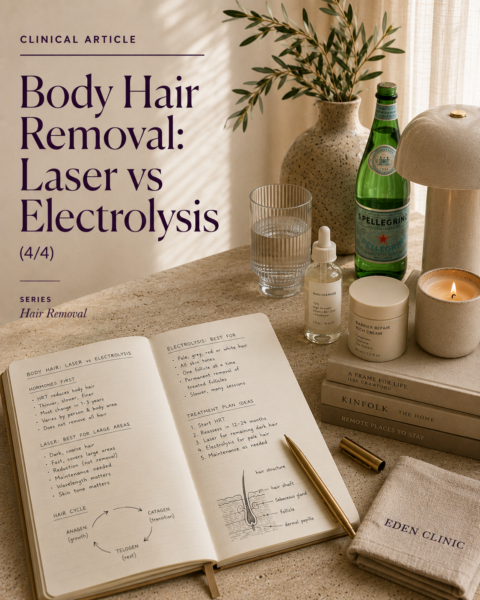
- Only anagen-phase follicles respond optimally — this is why multiple sessions spaced weeks apart are required
- Dark, coarse hair responds best; fine, light, grey, or white hair lacks sufficient melanin and does not respond
- Testosterone suppression matters: reducing androgenic stimulation limits new terminal hair recruitment and improves long-term outcomes
Laser hair removal is one of the most commonly requested procedures for trans women, and one of the most frequently misunderstood. The mechanism is specific, the limitations are real, and understanding both prevents unrealistic expectations and supports better treatment planning.
Selective photothermolysis
Laser hair removal works on the principle of selective photothermolysis. A laser emits light at a specific wavelength that is selectively absorbed by melanin — the pigment concentrated in the hair shaft and hair matrix cells — while passing relatively harmlessly through the surrounding skin. The absorbed light energy is converted to heat, which thermally damages the melanin-bearing structures and the adjacent follicular tissue responsible for hair production.
The structures most relevant to lasting hair reduction are the dermal papilla and the bulge stem-cell region of the hair follicle. Histological studies consistently show measurable thermal damage to the dermal papilla following treatment. The role of bulge stem cells is less settled — some studies have found these cells relatively intact even after clinically effective treatment, suggesting that damage to the dermal papilla, rather than direct destruction of bulge stem cells, may be the more important mechanism in many cases. The precise biological basis for lasting hair reduction is still an area of active research, even though the clinical effect itself is well established. The depth of follicular damage depends on laser wavelength, pulse duration, energy fluence, and cooling — all adjusted by the operator based on hair type, skin type, and treatment goals.
Wavelengths used for hair removal range from 600 to 1200 nm. The alexandrite laser (755 nm) offers high melanin absorption and strong efficacy, and is most commonly used for lighter skin tones. The diode laser (808 nm) offers intermediate characteristics. The Nd:YAG laser (1064 nm) penetrates more deeply and is safer for darker skin tones, where shorter wavelengths risk competing absorption by epidermal melanin — though with some reduction in efficiency compared with alexandrite in comparable hair.
Why multiple sessions are required: the hair cycle
Hair follicles cycle through three phases: anagen (active growth), catagen (transition), and telogen (resting). Anagen follicles respond best to laser treatment because bulb pigmentation is maximal, follicle depth is greatest, and the stem-cell niche is most actively coupled to the hair matrix. At any given time, only a proportion of follicles are in anagen — the exact proportion varies by body site, and is generally higher for facial hair than for body hair such as the legs or arms.
Each treatment session targets the follicles best positioned to respond at that time. Follicles in catagen or telogen are largely unaffected and will cycle back into anagen in subsequent weeks or months. This is why six to twelve sessions are commonly required for facial hair in trans women, spaced four to eight weeks apart. Six to eight sessions is often optimistic for dense beard growth, darker skin types, or hormone-resistant follicles — some individuals require more.
What works well and what doesn’t
Coarse, dark hair in people with lighter skin tones responds best, because dark hair contains the most melanin and lighter skin provides lower competing epidermal melanin absorption. Advances in Nd:YAG technology have substantially improved safety for darker skin tones, though efficacy trade-offs remain.
Fine, light, grey, or white hair does not respond to laser. These hairs contain insufficient melanin for meaningful energy absorption. Electrolysis — which destroys the follicle using electrical current and is effective regardless of hair colour — remains the appropriate method for light or grey hair and for residual hairs after a laser course.
A clinically important and often overlooked point: HRT-induced changes in hair texture can affect laser response over time. As testosterone suppression takes effect, some terminal hairs may become finer. This is beneficial in terms of overall hair density, but finer hairs contain less melanin and may respond less well to later laser sessions than the same hairs would have responded to earlier in transition. Planning treatment earlier, when hairs are still in their coarser pre-HRT state, is generally more efficient.
Why testosterone suppression matters
Androgens drive follicular recruitment — testosterone and DHT stimulate dormant follicles to enter the terminal hair cycle, producing new coarse hairs. Without adequate testosterone suppression, beard follicles can continue to cycle robustly, undermining the gains from laser treatment. Achieving and maintaining testosterone in the female reference range reduces ongoing follicular stimulation and improves long-term laser outcomes. Hormonal management and laser treatment are complementary, not separate.
Paradoxical hypertrichosis
A rare but important complication worth knowing about: paradoxical hypertrichosis — an increase in hair density following laser treatment. It occurs most commonly on the face, particularly in individuals with darker skin types, and is associated with low-fluence treatments that stimulate rather than damage follicles. It is uncommon, but patients should be aware it exists and should discuss it with their treating practitioner before beginning a course.
⚠️ Clinical note: The FDA-cleared claim for laser is “permanent hair reduction” — not permanent removal. Electrolysis carries the cleared claim for “permanent hair removal.” This distinction should be part of any informed consent discussion. Session number estimates are general guidance; individual requirements vary considerably based on hair density, colour, skin type, and hormonal status.
Sources
- Vaidya T, Hohman MH, Kumar DD. Laser Hair Removal. StatPearls [Internet]. Treasure Island (FL): StatPearls Publishing; updated 2023.
- Chiu HY, Wang WH, Kuan CH, Wu YF, Tseng CJ, Huang WY, Wang SH, Lin SJ. Depilatory laser miniaturizes hair by inducing bystander dermal papilla cell necrosis through thermal diffusion. Lasers Surg Med. 2022;54(6):916–927.
- FDA Center for Devices and Radiological Health. Correspondence with the American Electrology Association confirming regulatory distinction between “permanent hair reduction” (laser) and “permanent hair removal” (electrolysis) clearances.