Version: 1.0 · Status: Superseded · Published: 28 June 2026 · Superseded: 3 September 2026 by v2.0.
This guide has been superseded. It describes the position before the new school-year guidance took effect. On 1 September 2026, KCSIE 2026 and the revised RSHE guidance came into force, changing the framework for handling a disclosure. This version is kept, unchanged, as a record of the earlier position.
Correction, 11 September 2026. Some advice in this record should not be relied on. It says a disclosure should ordinarily be passed to the designated safeguarding lead. KCSIE 2026 says that where a child confides in a member of staff but does not ask the school to change how they are treated, there is no reason to break that confidence unless there is a related safeguarding risk (paragraph 271). It also attributes consultation figures from the 2023–24 consultation on an earlier non-statutory draft to the 2026 consultation. Both errors were carried into the updated guide and corrected there on 11 September 2026. The updated guide went live on 2 September 2026, not 3 September as the line above states.
For the current guidance → read the updated guide.
TL;DR
- When a pupil tells you they are trans, that is first a safeguarding moment, not a decision about transition.
- England has no settled rulebook for it yet: the RSHE curriculum guidance (statutory from September 2026) treats gender as a contested topic to teach carefully, while the guidance on how to handle an individual disclosure has been folded into Keeping Children Safe in Education but is not yet final — its consultation closed in April 2026 and the finished version is still pending as this is written (mid-2026), with KCSIE 2025 the operative guidance in the meantime.
- A defensible way to respond while that gap stands: don’t promise confidentiality, route the disclosure to your designated safeguarding lead, treat involving parents as the usual starting point while holding open the genuine-risk-of-harm exception, weigh the pupil’s understanding and any additional needs, and write down your reasoning.
- The argument underneath: the missing map is the real failure, not the teacher caught without one.
A pupil says it quietly, or sideways, or in the middle of a conversation about something else: they think they’re trans. The adult in the room does the right things — listens, remains calm, takes it seriously — and then comes the harder part. They take it to the person whose entire job is to know what happens next — and find that, here, even that person may have no settled answer to give.
That second silence is the one worth paying attention to. When a teacher is unsure, that’s ordinary. When the designated safeguarding lead is unsure — the role built precisely to hold the next step — you are no longer looking at one professional’s gap in knowledge. You are looking at a gap in the system itself. And in England right now, that gap is real, and it is not anyone in the building’s fault.
Why there’s no script
It is tempting to read a school’s hesitation here as squeamishness, or as not caring enough. Usually it is neither. It is that the ground has genuinely moved, and no one has been handed a finished map.
Two different documents are meant to help, and neither closes the gap. The first is the revised Relationships, Sex and Health Education guidance, published in 2025 and statutory from September 2026. It tells schools what to teach — and it treats sexual orientation and gender strikingly differently. Same-sex relationships are framed warmly and woven through the curriculum: primary schools are encouraged to include same-sex parents when teaching about families, secondary schools to integrate same-sex relationship content throughout rather than bolt it on. Gender is framed as contested ground: teach the facts and the law on biological sex and gender reassignment, but treat gender identity as a matter of significant debate, don’t present any particular view as fact, and don’t imply that social transition is a simple fix for distress. Whatever one makes of that balance, the asymmetry is written into the statutory document itself. Orientation has reached relatively settled ground; gender has been marked, in effect, as “handle with caution”.
That asymmetry shows up in how teachers report feeling. A 2025 study of teachers in England delivering LGBTQ+-inclusive RSE found confidence generally low and uneven access to training and resources — and singled out teaching about gender identity as the specific area teachers found hardest. It is worth being precise about the limits of that evidence: it is a small study, of 72 teachers, and it concerns delivering the curriculum rather than handling a one-to-one disclosure. There is, as far as we can find, no large representative survey that cleanly isolates teachers’ confidence on gender or trans pupils from their confidence on sexual orientation — which is itself part of the problem. The terrain where staff feel least sure is also the terrain least well measured. The absence of stronger evidence should not be mistaken for evidence that confidence is high.
But that document governs the curriculum — what is taught to a class. It says almost nothing about what an individual member of staff does when a particular child discloses. That second thing is meant to live in the gender-questioning children guidance, which the government has folded into Keeping Children Safe in Education, the statutory safeguarding framework. That guidance is still not final: its consultation ran from February to April 2026 and has closed, but the finished version had not been published as this was written, and KCSIE 2025 remains the guidance schools actually operate under in the meantime. The one document intended to provide detailed, gender-specific guidance for responding in that moment does not yet exist in settled form.
And the parts schools most need are precisely the parts that have proved hardest to settle. When the DfE consulted on the earlier draft, the sections respondents were most dissatisfied with were the ones on responding to a child’s requests and engaging parents, and on pronouns — 74 percent and 73 percent respectively felt those sections did not give schools enough to go on. The department’s own summary called it a highly contested area with no clear consensus. In other words, the hard cases — the exact situation a teacher faces when a child discloses — are where many consultation respondents judged the draft framework thinnest.
So the picture a school faces is not neglect. It is a curriculum framework that flags gender as contested, a disclosure framework that is unfinished, and a clinical landscape (more on which below) that has been overturned in the space of two years. The destabilising forces — the Cass Review, the puberty blocker ban, guidance redrafted and redrafted again — are real and recent. A teacher standing in front of a child who has just trusted them with something is being asked to navigate all of it without a finished rulebook. That is why even a safeguarding lead can be left without a settled answer. The map isn’t late to that person’s desk. It is still being drawn.
What follows is not that missing rulebook. It is a way to reason through the moment that is defensible under the law and the guidance as they stand — principles to find your feet on, precisely because there is no script to follow.
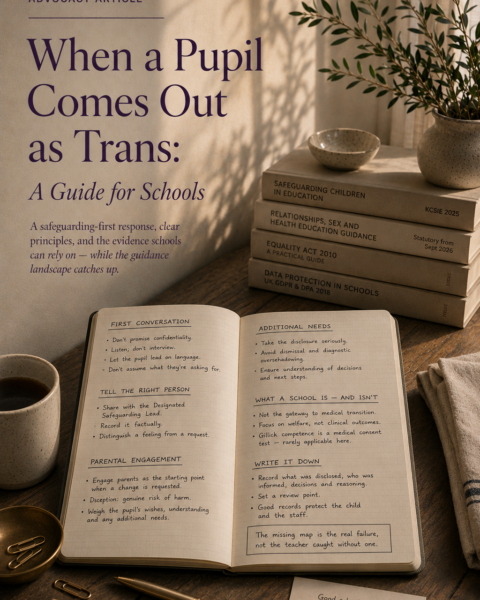
In the first conversation
Most of what matters in the first conversation is restraint. The pupil has handed you something; the job is to receive it well, not to resolve it.
- Don’t promise confidentiality. This is the one firm rule across every version of the guidance. You can listen warmly and you do not have to alert anyone in that instant — but you cannot promise the child that what they’ve said stays only with you, because safeguarding may require it to be shared. If you’ve already implied secrecy, gently correct it rather than let it stand.
- Listen; don’t interview. A disclosure is not a referral form. You don’t need the whole story, a timeline, or a label. Warmth and a few open questions do more than a checklist.
- Let the pupil lead on language. Use the name and words they use about themselves in that conversation, without committing the school to anything formal. Mirroring a child’s language in conversation is not the same as enacting a formal change or making a safeguarding decision.
- Don’t assume what they’re asking for. “I think I’m trans” is a disclosure of feeling. It is not automatically a request for the school to change names, pronouns or uniform. Treating a quiet confidence as a formal request for action escalates something the child may not have asked to escalate.
Straight after: tell the right person
The instinct to handle it yourself — to protect the child’s trust by keeping it close — is decent and wrong. A disclosure like this from a child should ordinarily be shared with the designated safeguarding lead, in line with the school’s safeguarding procedures. That protects the pupil, because the DSL can see the whole picture and the school’s duties in the round; and it protects you, because these are not judgements any single member of staff should be carrying alone.
Telling the DSL is not the same as telling the parents. It is an internal step, the mechanism that exists so the parental question gets weighed properly rather than decided in a corridor. Two things help the DSL do that:
- Record it factually. What was said, when, in what context — in the pupil’s terms, without interpretation or diagnosis. You are logging an event, not reaching a conclusion.
- Distinguish a feeling from a request. Note clearly whether the pupil simply disclosed, or actually asked the school to do something. That distinction shapes everything that follows, including how the parental question is approached.
The hardest question: the parents
This is where schools freeze, and where the temptation to reduce it to a single rule is strongest. There isn’t one. There is a default and an exception, and the work is in holding both.
The current policy direction is that engagement with parents should ordinarily be the starting point — and it attaches most clearly once a child is requesting an actual change the school would be asked to support, such as a name, pronoun or uniform change. The draft framework is explicit that schools should not set this in motion themselves; the question arises when a child or parent raises it, not when a teacher decides to act on a disclosure. The exception is the genuine one: where involving parents would itself place the child at significant risk of harm. That carve-out exists for real situations, not as a loophole, and a school cannot wave it through casually — but nor can it pretend the home is always safe.
Between those poles, two principles do most of the steadying. The pupil’s wishes carry real weight, but they are weighted input into a safeguarding decision, not a veto that ends it — a child cannot bind the school to silence, and the school cannot outsource the judgement to the child. And you never promise secrecy, but you also don’t rush to disclose; the right move is usually to work the question through the safeguarding process, with the pupil’s views, their safety, and their understanding all on the table, rather than to default to telling parents reflexively or to telling no one at all.
For staff, the honest framing to offer a worried colleague is this: your job is not to decide, alone and on the spot, whether the parents are told. Your job is to get the disclosure to the people who weigh that properly, and to make sure the child’s wishes and any risks are part of what they weigh.
When the pupil has additional needs
Some disclosures arrive from children with communication differences, learning disabilities, or neurodivergence — and the temptation then runs in two opposite, equally unhelpful directions.
One direction is dismissal: treating an autistic or learning-disabled child’s disclosure as confusion to be managed rather than a feeling to be heard. The other is its mirror: a single-minded focus on gender that lets every other need go unexamined — what clinicians call diagnostic overshadowing. The Cass Review emphasised holistic assessment for exactly this reason, recommending that young people referred to gender services receive a full assessment of their needs, including screening for neurodevelopmental conditions, rather than a gender-only lens. That principle is contested — critics argue neurodivergence has been used to cast doubt on trans young people’s accounts of themselves — and the tension is real. For a school, the practical resolution is narrower and less fraught than the clinical debate: take the disclosure seriously, and make sure the child’s wider needs are held alongside it, not instead of it.
The other thing additional needs change is the question of understanding. Was the disclosure understood by the adult as the child meant it? Does the pupil grasp what a step like “telling my parents” would actually involve for them? These are not reasons to discount a child. They are reasons to bring in the people who know that pupil’s communication and capacity well, rather than to let one conversation carry more certainty than it can bear.
What a school is — and isn’t
A quiet pressure sits under these meetings: a sense that the school is being asked to open a door onto medical transition, and had better get the decision right. It helps to name what the school actually is in this picture, because it is far less than that fear assumes.
For an under-18 in England as things stand in mid-2026, the medical pathway has effectively closed. Puberty blockers for gender dysphoria are subject to an indefinite ban, due for review in 2027; the NHS stopped routine prescription in 2024 and the only remaining route was a clinical trial — which was itself paused in February 2026, before recruiting anyone, over safety concerns. Routine prescription of gender-affirming hormones to under-18s is, separately, the subject of an NHS England consultation proposing to stop it. The realistic clinical picture for a child presenting now is referral into an NHS gender service for holistic assessment and support, with long waits, and no access to blockers or hormones under current rules. Psychological support and broader paediatric care remain available where clinically appropriate. This is a fast-moving area; the dates matter.
This is why the school should not see itself as the gateway to medical transition. Its safeguarding role is distinct from clinical decision-making, and its responsibilities stay centred on the child’s welfare rather than on determining clinical outcomes. That reframing also lowers the temperature of the room, because it relocates the decision from one nobody in the building is qualified to make to one they are — how to care for this child well.
It is also where the much-invoked idea of Gillick competence belongs, and doesn’t. Gillick is a test of whether a particular child has the maturity to consent to a particular piece of medical treatment. It is assessed decision by decision; it is not switched off because a child attends a special school or has a diagnosis. But it is a medical-consent test — and with the medical pathway closed to new under-18 patients, there are currently very few medical decisions in this pathway to which it is likely to apply. It is not the framework that governs a disclosure in a classroom. Safeguarding, the child’s best interests, the Equality Act 2010, and data protection law (the UK GDPR and the Data Protection Act 2018) are.
Write it down
Whatever is decided, record the reasoning, not just the outcome: what was disclosed, who was informed, how the parental question was weighed, what the pupil wanted, what was done and why. Set a point to review it, because a child’s situation and wishes change. This is not bureaucratic cover. It is what turns an anxious, improvised decision into a defensible, child-centred one — and it is precisely what the safeguarding framework, once it is finished, will expect schools to have done all along.
The gap is the point
Return, at the end, to that second silence — the safeguarding lead who found no settled answer to give. It is easy to read it as a failure, and easier still to make it a personal one. It isn’t. The teacher who listens well, the lead who hesitates because the guidance genuinely doesn’t resolve cleanly, the school that reaches for a process and finds it half-built — these are people behaving responsibly inside a system that has not yet given them what it owes them.
The failure is not the adult caught without a map. It is that the most exposed children in our schools — the ones disclosing something tender, sometimes with communication or learning needs layered on top — have been left to professionals the system has not yet properly equipped for this moment. Finding your feet, conversation by conversation, is what good people do when no one has drawn the path. They shouldn’t have to. The children disclosing shouldn’t have to depend on whether the adult in front of them happened to find theirs.
Sources
This guide reflects guidance and policy in England as of mid-2026. Schools policy is devolved, so the position differs in Wales, Scotland and Northern Ireland. Some of the frameworks below are not yet final — the KCSIE 2026 consultation closed in April 2026 and the finished guidance is expected later in 2026 — so the position is subject to change and should be checked against the latest published versions.
- Department for Education, Relationships Education, Relationships and Sex Education (RSE) and Health Education — statutory guidance, July 2025 (in force from September 2026): RSHE statutory guidance.
- Department for Education, Keeping Children Safe in Education 2025 — the statutory safeguarding framework currently in force, relied on throughout this guide: [add live GOV.UK KCSIE 2025 URL].
- Department for Education, guidance on children who are questioning their gender within Keeping Children Safe in Education — proposed in the KCSIE 2026 draft; consultation ran February to April 2026 and has closed, final version pending: government announcement and consultation detail and response summary (including the proportions of respondents who found the requests/parents and pronouns sections under-detailed).
- C. L. Fox et al., teachers’ perceptions and experiences of delivering LGBTQ+-inclusive RSE in England, Sex Education (2025) — small survey study (n=72) reporting low teacher confidence and identifying gender identity as the area teachers found hardest: journal article.
- House of Commons Library, Hormone treatments for children and young people: clinical trial and consultations (puberty blocker ban, trial pause, hormone consultation): research briefing.
- Department of Health and Social Care, indefinite ban on puberty blockers for under-18s: policy announcement.
- NHS England, implementing the Cass Review recommendations (holistic assessment, including screening for neurodevelopmental conditions): implementation overview.
- House of Commons Library, Provisions to support gender-questioning children in schools: research briefing.